Introduction
A kurti can look perfectly opaque on a hanger and suddenly reveal every seam underneath once you step into daylight.
That’s the part people often miss.
With everyday Indian wear, choosing a bra is not always about finding the “right style” for a neckline. More often, it comes down to how the fabric behaves once you actually wear it.
A white cotton kurti may become more transparent in sunlight. Chikankari can reveal the layer underneath through the embroidery. Soft rayon and jersey can cling closely enough to show lace, cup edges, or even strap adjusters. Linen and handloom cotton, on the other hand, often hide much more than you would expect because the surface itself has texture.
So the question is not simply: “What bra goes with this kurti?”
It is: “What will this fabric reveal, and what do I want the layer underneath to do?”
Sometimes the answer is a smooth skin-tone bra.
Sometimes it is a camisole.
Sometimes the cleanest fix is lining the kurta instead of adding another layer every time you wear it.
And sometimes the fabric is already forgiving enough that you can stop worrying about making everything underneath completely invisible.
This guide looks at seven common kurti and kurta situations — from white cotton and Chikankari to fitted rayon, linen, sleeveless styles, sheer festive fabrics, and office kurtas — with the focus on visibility, layering, comfort, and how the outfit behaves in real life.
Because under a kurta, the best foundation is usually the one you stop noticing once you leave the mirror.
1. The White Cotton Kurti Test
 Pin it
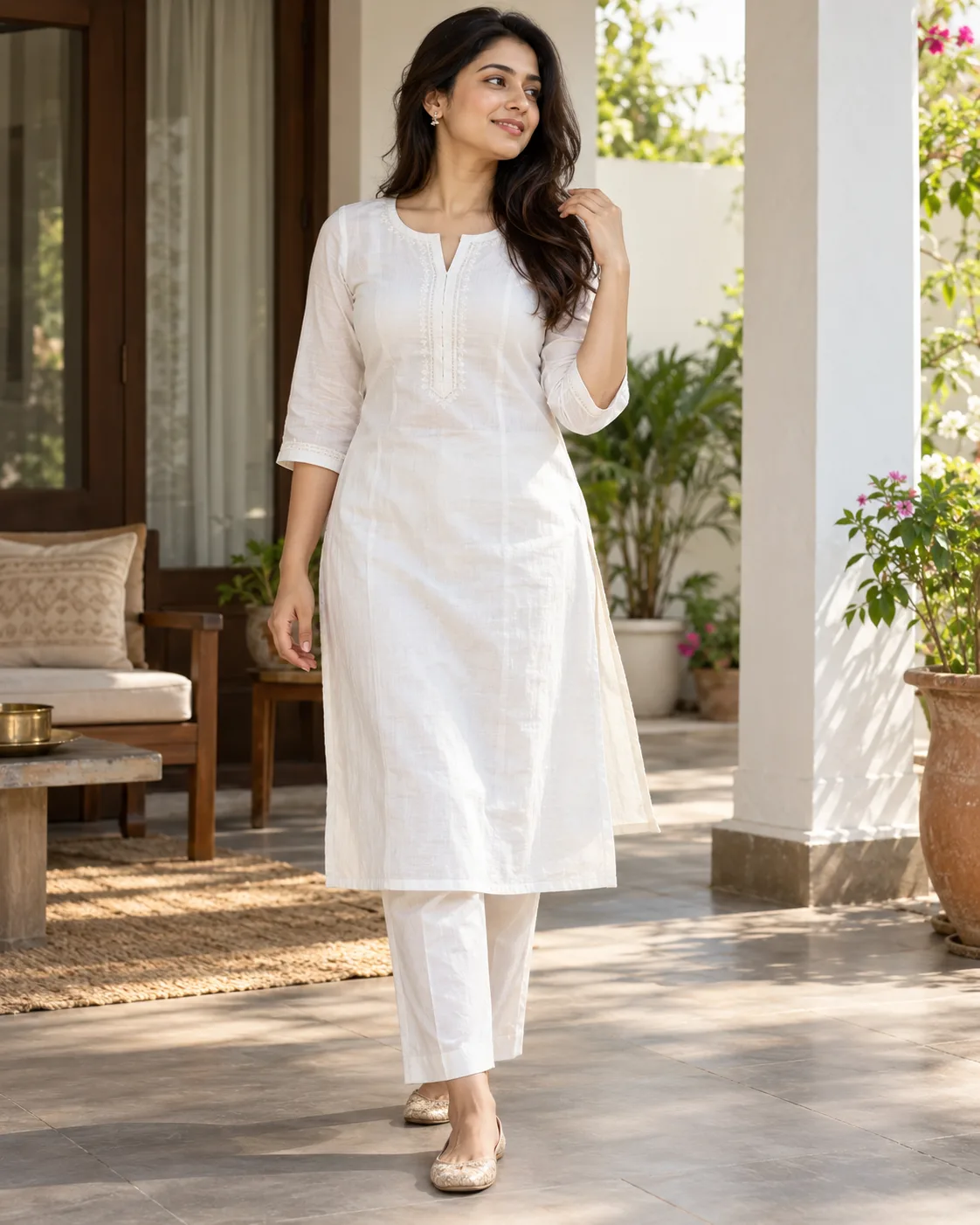
White cotton looks simple, but it is one of the easiest fabrics to misjudge.
A kurti can seem completely opaque in your bedroom mirror and look noticeably more transparent once you step outside. Thin cotton also stretches slightly across the bust, which can make seams, cup edges, lace, or strong colour contrast much easier to see.
That is why I would not automatically reach for a white bra under a white kurti.
A skin-tone bra usually disappears more naturally because it creates less contrast against the body underneath the fabric.
The finish matters just as much as the colour.
A smooth, lightly lined or seamless cup tends to sit more quietly under thin cotton than:
lace
raised embroidery
thick seams
heavily moulded edges
decorative straps
If the kurti is only slightly sheer, that may be all you need.
But if you can clearly see the outline of the bra or your skin through the entire garment, changing bras may not solve the whole problem.
That is where a lightweight camisole or additional lining becomes more useful.
I’d always do one quick test before leaving:
Put the full outfit on and stand near a window in strong natural light.
Then look from the front and the side.
If you stop noticing what is underneath and your eye goes back to the kurti, the foundation is doing its job.
The point is not to make white cotton complicated.
It is just to remember that indoor opacity and daylight opacity are not always the same thing.
2. Chikankari Changes the Question
 Pin it
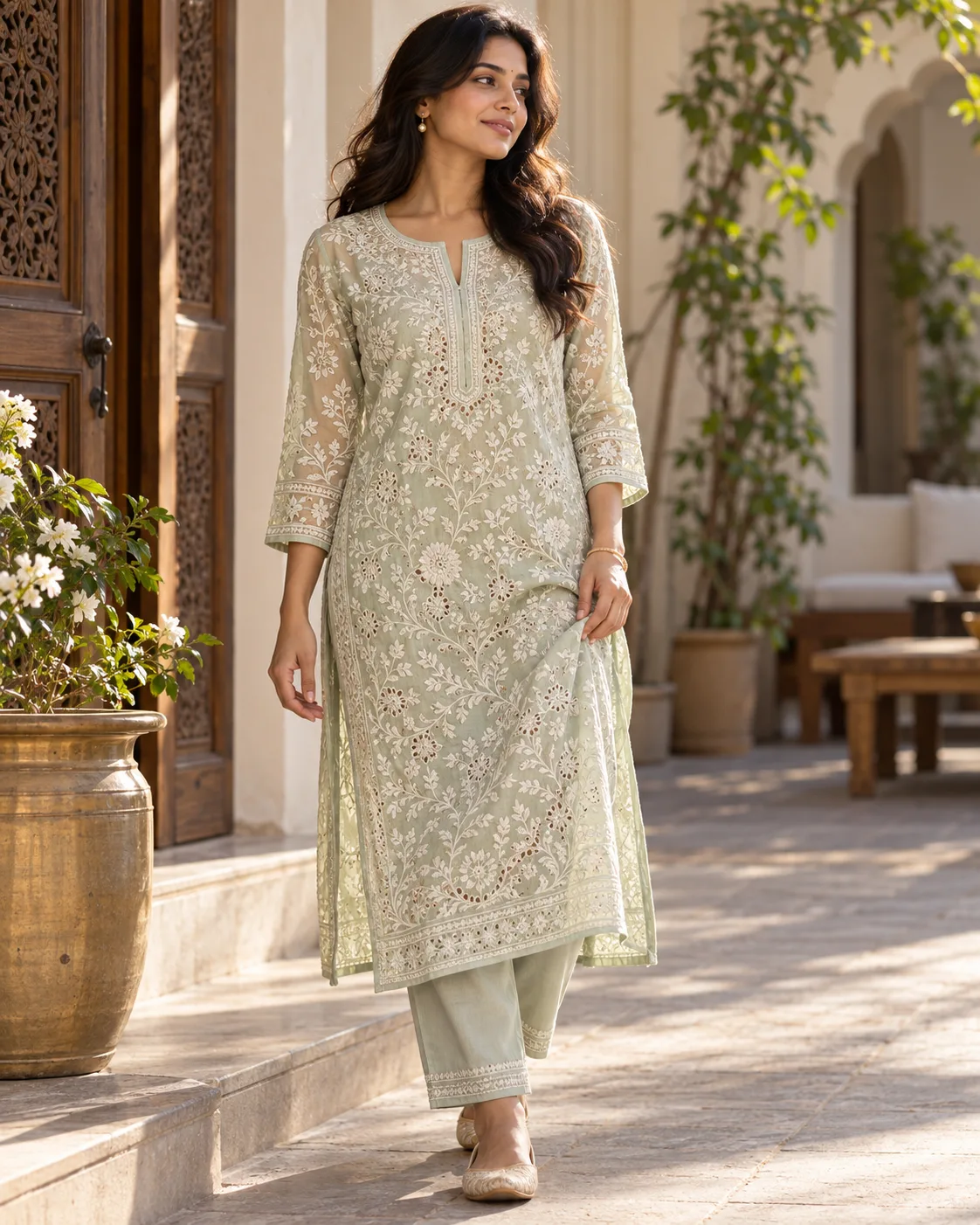
Chikankari is different because the embroidery itself often creates small open areas where the layer underneath becomes part of the look.
So the goal is not always to make everything disappear.
Sometimes the better question is:
What do I want the embroidery to look like against the layer underneath?
There are three good directions.
Keep It Invisible
If you want the Chikankari itself to be the focus, use a smooth skin-tone bra and, if needed, a tonal camisole underneath.
This works especially well with:
white Chikankari
ivory
pale pastels
fine cotton styles
The layer underneath should almost disappear so the threadwork stays visually clean.
Keep It Tonal
A cream camisole under an ivory kurti, or a pale beige layer under soft blush, can create a softer effect than trying to match skin tone exactly.
This works nicely when the embroidery is dense enough to make the outfit feel layered rather than sheer.
Make the Contrast Intentional
You can also use contrast on purpose.
A black inner layer under white Chikankari, for example, can make the embroidery stand out much more strongly.
But this only works when the contrast looks deliberate.
If the layer underneath is visible in random patches or the bra itself becomes the focal point, the outfit can start to feel unfinished.
For more ways to style the fabric itself, our Chikankari Kurti Outfit Ideas for Women explores how colour, trousers, layering, and proportion can make Chikankari feel more modern.
With Chikankari, the best foundation is not always the one you can’t see.
It is the one that makes the embroidery look the way you intended.
3. Fitted Rayon, Viscose or Jersey Kurtis Show More Than You Think
 Pin it
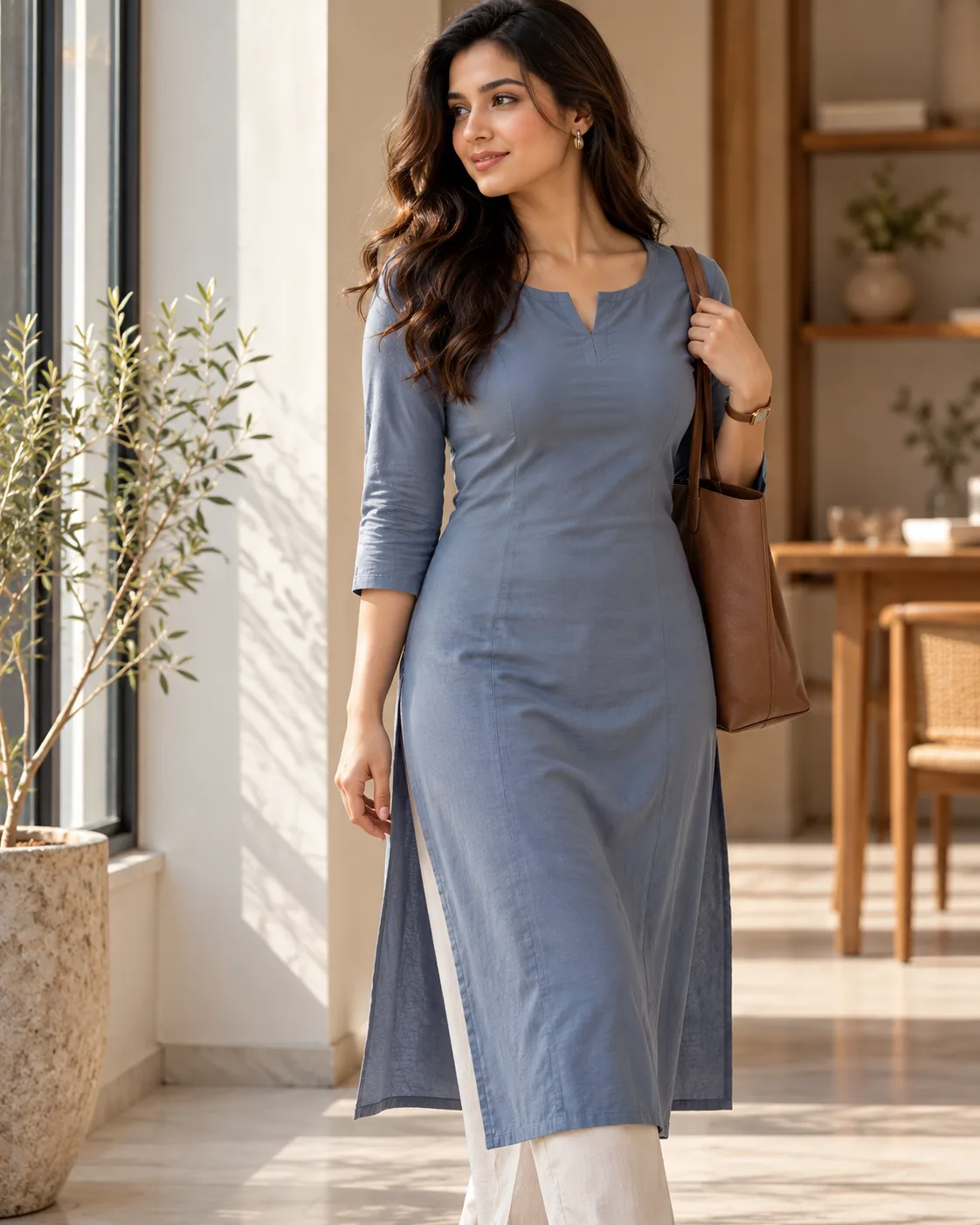
Soft, stretchy kurtis have a different problem from white cotton or Chikankari.
They are often opaque enough that colour is not the issue.
What shows instead is texture.
A fitted rayon or jersey kurti can reveal:
lace
cup seams
thick edges
strap adjusters
decorative stitching
even slight puckering underneath
The fabric drapes closely over the body, so anything raised beneath it can become visible even when the bra itself is the right colour.
This is where a smooth T-shirt bra or seamless style usually makes sense, but the reason matters.
You are not choosing it because the kurti is fitted in some abstract way.
You are choosing it because the outer fabric is soft enough to copy the shape of whatever sits underneath.
One easy test is to put the kurti on and stand sideways under direct light.
If you can clearly make out the construction of the bra through the fabric, simplify what is underneath.
That might mean:
smoother cups
fewer seams
less lace
flatter hardware
You do not necessarily need more padding or more structure.
In fact, a heavily moulded bra with thick edges can sometimes show more than a lighter, smoother one.
The useful rule here is simple: the softer and clingier the kurti fabric, the quieter the surface underneath should be.
4. Linen and Handloom Kurtas Don’t Need the Same Solution
 Pin it
Not every kurta needs the smoothest possible bra underneath.
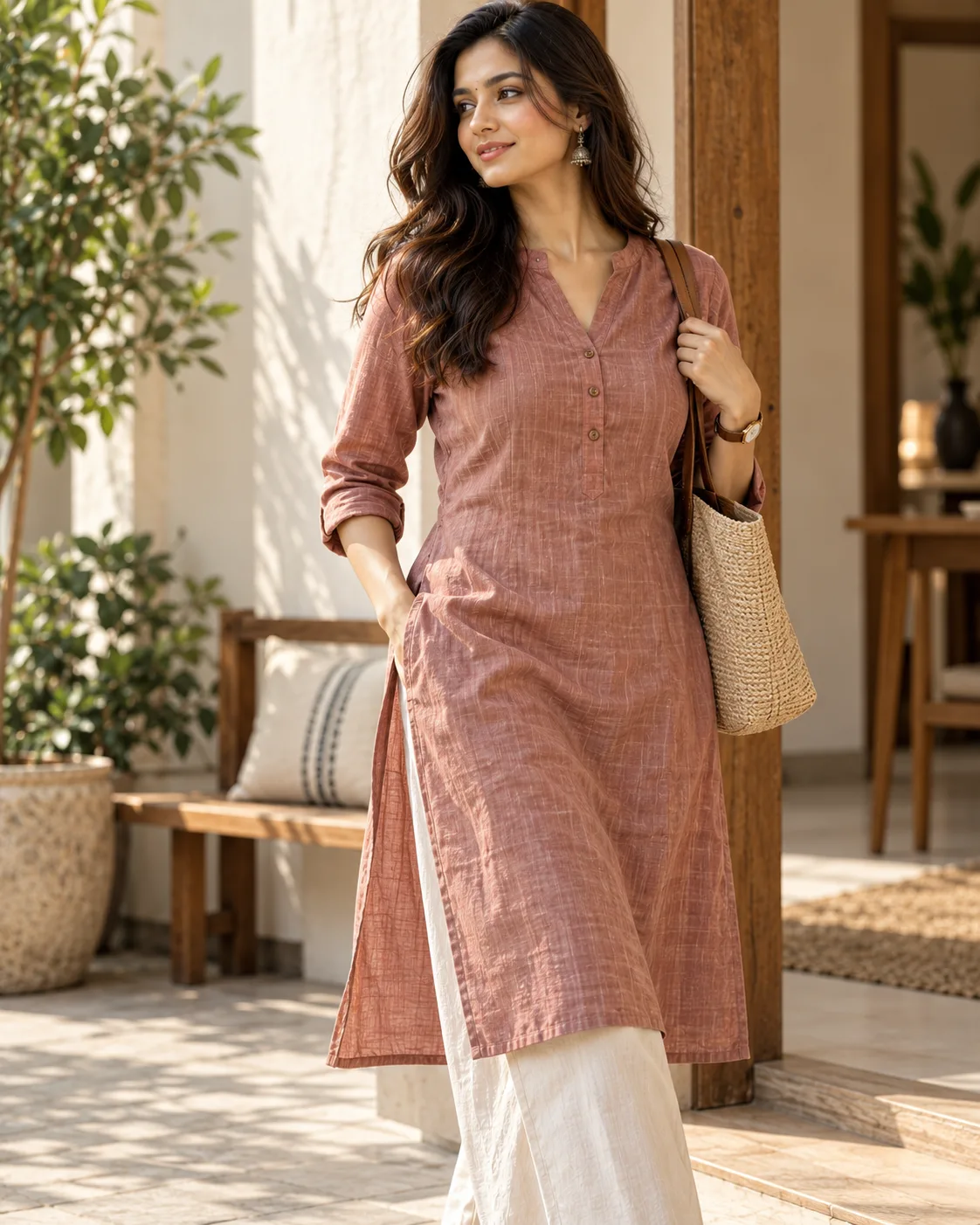
Linen, khadi, handloom cotton, and slub fabrics often have enough natural texture to disguise small seams and cup edges that would be obvious under rayon or jersey.
That changes the priority.
Instead of asking: “Will every line show?”
you can think more about:
comfort
breathability
preferred coverage
how long you’ll wear the outfit
how the fabric feels against the body
A lightly textured handloom kurta can often handle a regular everyday bra perfectly well, even if that same bra looks too visible under a close-fitting viscose top.
This is also why I wouldn’t recommend seamless construction automatically.
Sometimes it is useful.
Sometimes the kurta fabric is already doing enough to hide what is underneath, and chasing a completely invisible foundation only adds unnecessary restriction.
For a relaxed linen kurta, for example, I’d probably prioritise something breathable and comfortable over something heavily moulded just because it looks “smoother” on paper.
The same applies to thicker cottons and textured festive fabrics.
Before changing anything underneath, look at what the outer fabric is already hiding.
That small distinction can save you from solving a problem the kurta never actually had.
5. Sleeveless Kurtis: Check the Armhole, Not Just the Strap
 Pin it
With sleeveless kurtis, people often focus so much on hiding the bra strap that they miss what is happening at the side.
A deep armhole can expose much more than the strap.
It can reveal:
the side wing of the bra
part of the cup
the band near the underarm
hardware that sits farther back than expected
So before changing bras, look at the kurti from the side.
Raise one arm naturally and check what appears through the armhole.
If the shoulder strap is the only problem, a convertible bra may be enough. Repositioning or crossing the straps can sometimes bring everything neatly inside the garment.
But if the side of the bra itself is showing, changing the strap arrangement will not fix it.
You may need a style with a cleaner or narrower side profile, or the kurti may simply need a slightly higher armhole.
This matters with modern sleeveless kurtis because the cuts can vary enormously. Some are almost like regular tops with the sleeves removed. Others have narrow shoulders, deep sides, racerback-inspired shapes, or very open armholes.
I also wouldn’t automatically switch to a strapless bra.
If a regular bra stays completely hidden, there is no reason to give up the comfort and stability of straps just because the kurti has no sleeves.
The fitting-room check I’d use is simple: look front, side, then raise your arm.
That usually tells you much more than the word “sleeveless” ever will.
6. Sheer Chanderi, Organza and Fine Festive Kurtas Need a Layering Decision
 Pin it
A sheer kurta does not automatically mean you need a different bra.
Sometimes the cleaner solution is to change the layering strategy instead.
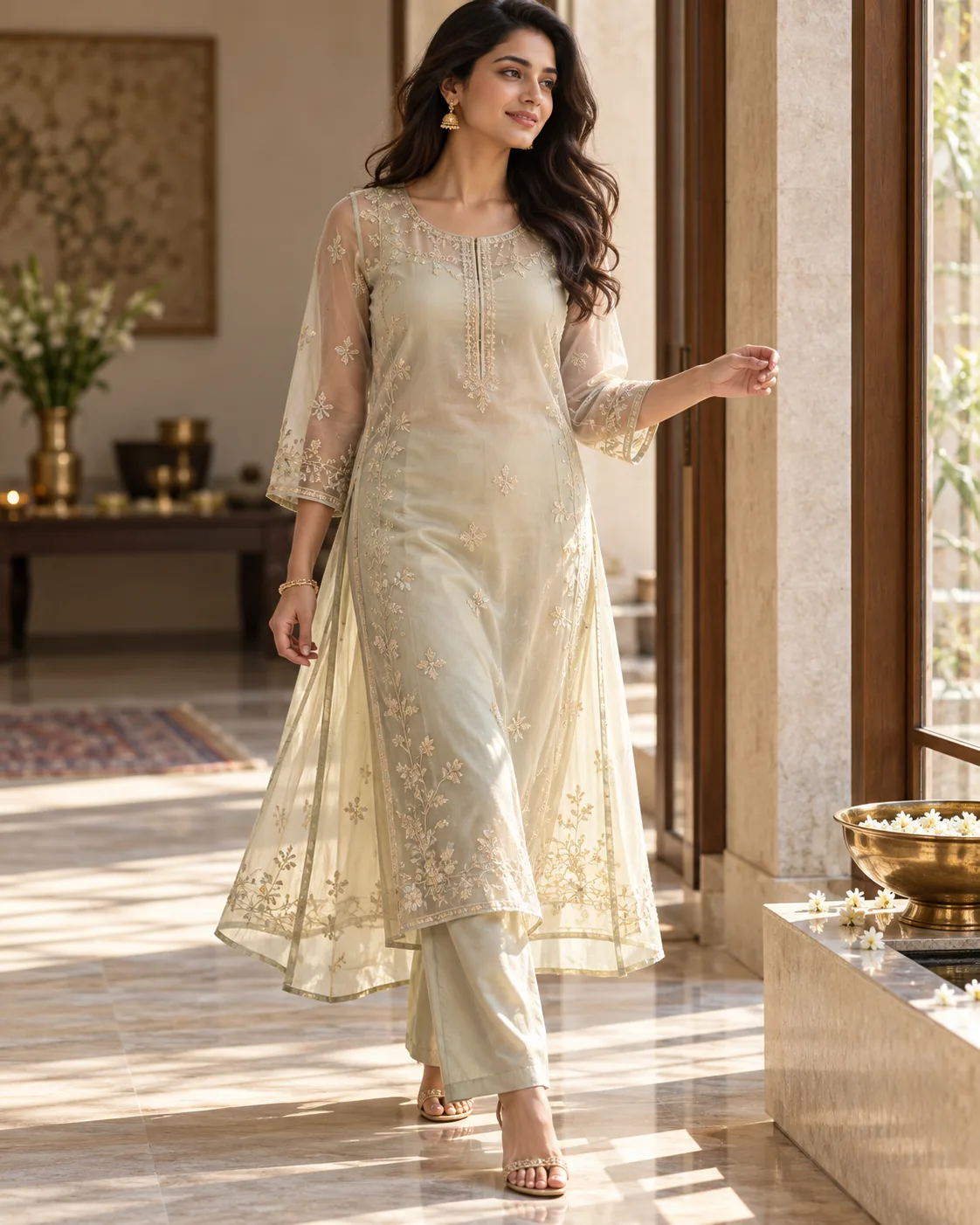
Chanderi, organza, fine georgette, and lightweight festive fabrics can reveal the outline of whatever sits underneath, even when the bra itself fits perfectly.
At that point, you have three choices.
Let the Bra Disappear
If the fabric is only slightly transparent, a smooth skin-tone bra may be enough.
This works best when you want the kurta itself to stay light and airy without adding another visible layer underneath.
The closer the bra is to your skin tone, the less contrast it usually creates through pale fabric.
Add a Camisole
If the entire kurta is noticeably sheer, a camisole can give you more consistent coverage than simply changing the bra.
But choose the camisole carefully.
A thick cotton layer under delicate Chanderi or organza can change the way the kurta falls, especially around the bust and waist.
For lighter fabrics, I’d look for something:
smooth
lightweight
close-fitting
simple at the neckline
The goal is to support the kurta, not make it feel heavier.
Line the Kurta
If you repeatedly find yourself managing transparency every time you wear the same piece, lining may be the better long-term answer.
A good lining can make the outfit feel more finished and remove the need to coordinate an extra inner layer every time.
This is especially useful with festive kurtas where the outer fabric already has embroidery, shimmer, or delicate surface work.
The trade-off is that lining can reduce some of the airiness and movement of the original fabric, so it needs to be chosen carefully.
That is why I would not treat bra, camisole, and lining as interchangeable fixes.
They solve slightly different problems.
If the issue is the bra showing, change the bra.
If the whole garment is sheer, think about the layer.
If the transparency is permanent, consider fixing the garment itself.
That usually leads to a cleaner result than buying another specialised bra for a problem the fabric is creating.
7. The Office Kurta Problem Is an Eight-Hour Problem
 Pin it
An office kurta is not really a five-minute mirror test.
It has to survive a commute, hours of sitting, reaching for things, walking between rooms, heat, and probably a few moments when you stop thinking about your clothes altogether.
That changes what matters underneath.
For workwear, I’d pay less attention to whether the bra feels “special” and more attention to whether it stays comfortable and predictable over time.
A few things matter more than they do for a short evening outfit:
the band should stay secure without feeling restrictive
the straps should not need constant adjustment
the fabric should feel breathable enough for a long day
the cups should stay smooth under the kurta
the bra should not start digging in once you have been sitting for hours
This is also where overly decorative bras can become less practical.
Lace, thick seams, and raised details may look fine under a looser kurta, but if your office style includes fitted cotton, rayon, or straight-cut kurtas, a smoother everyday bra is usually easier to forget about.
And that is really the goal.
The bra that looks perfect for five minutes in a fitting room may not be the one you want under a kurta from 9 a.m. to 6 p.m.
I’d choose the version that still feels comfortable at the end of the day — even if it is not the most structured or polished-looking option in the drawer.
Because for office dressing, the best foundation is usually the one that does its job quietly and stays out of your way.
Bra, Camisole or Lining: Which One Actually Solves the Problem?
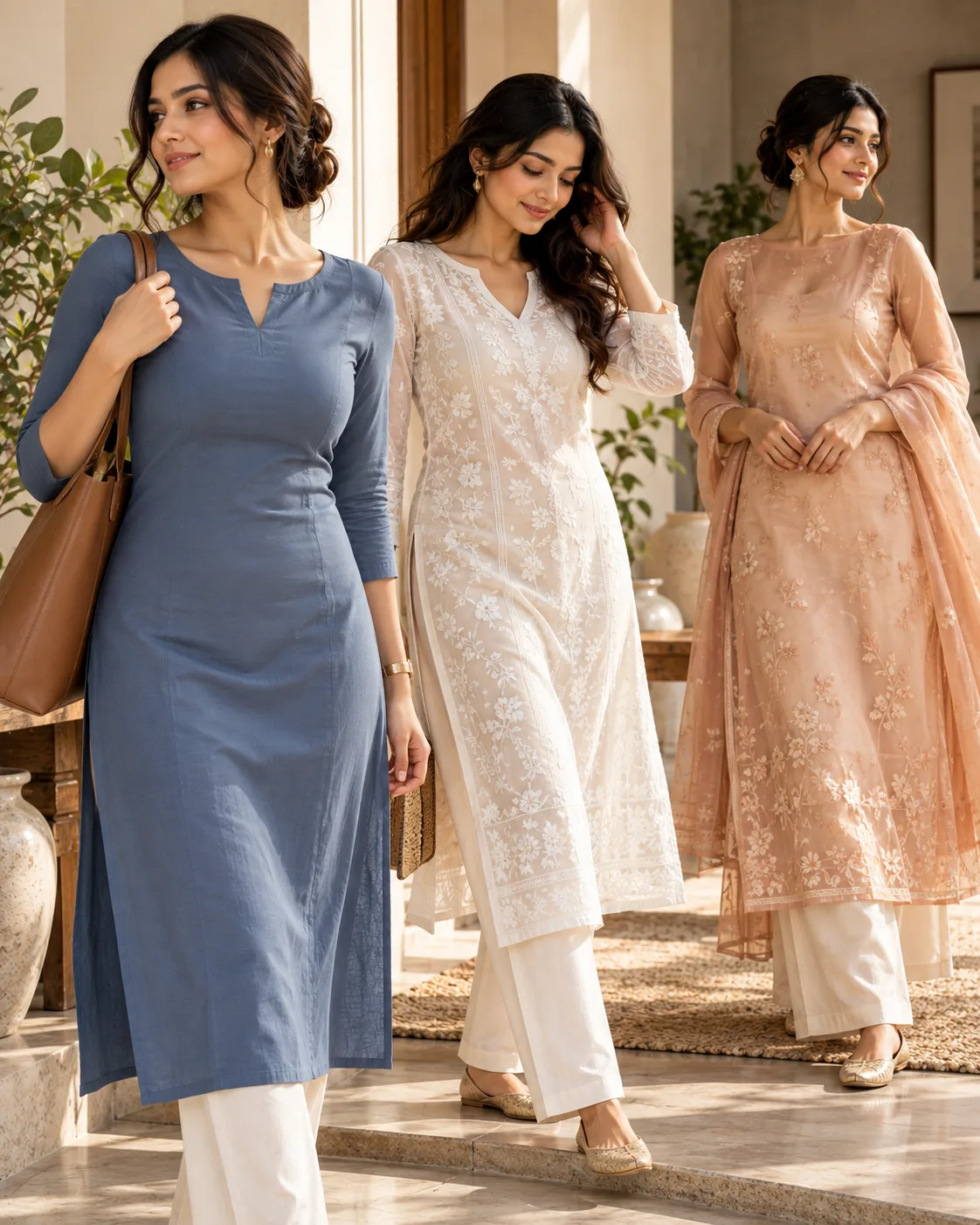 Pin it
One of the easiest ways to overcomplicate a kurti is to solve the wrong problem.
Sometimes you need a different bra.
Sometimes you need another layer.
And sometimes the kurta itself is the thing that needs changing.
Those are three very different situations.
Choose a Different Bra When the Problem Is Local
If the issue is concentrated around the bust, the bra is probably the right place to start.
For example:
seams showing through fitted fabric
lace creating texture
cup edges appearing under a close-fitting kurti
strong colour contrast under pale fabric
straps or side wings appearing through the garment
In those cases, changing to a smoother, quieter foundation may be all you need.
There is no point adding an entire camisole if the only thing bothering you is one visible seam.
Add a Camisole When the Whole Kurta Is Slightly Sheer
A camisole makes more sense when transparency continues beyond the bust.
If you can see through the front, back, and lower part of the kurta, changing the bra only solves one small section of the problem.
A lightweight camisole creates one consistent base underneath.
This works particularly well with:
fine cotton
Chanderi
lighter Chikankari
georgette
semi-sheer handloom fabrics
The important part is choosing a layer that does not fight with the kurta.
A bulky camisole can change the drape, create extra lines, and make a breathable summer kurta feel much warmer.
The best inner layer should almost behave like part of the garment.
Choose Lining When You Are Solving the Same Problem Every Time
If you own a kurta that always requires careful underwear planning because the entire garment is too transparent, it may be worth fixing the garment instead.
Adding lining can make sense when:
the kurta is consistently sheer
you wear it often
you do not want a visible inner layer
the outer fabric has embroidery or detail worth preserving
you want the outfit to feel more self-contained
This is particularly useful for festive pieces.
You may not want to think about which camisole works every single time you wear an embroidered organza or Chanderi kurta.
But lining comes with a trade-off.
It can reduce:
airiness
movement
breathability
some of the delicacy of the original fabric
So I would not line every sheer kurta automatically either.
A Simple Way to Decide
Ask where the problem begins.
Only around the bust?
Look at the bra.
Across most of the garment?
Consider a camisole.
Every time you wear the same kurta?
Think about lining.
That distinction is more useful than automatically buying another bra whenever something looks wrong underneath.
Sometimes the best underwear solution is not underwear at all.
Final Thoughts
Choosing what to wear under a kurti gets much easier once you stop treating every outfit like a bra-style problem.
Sometimes the real issue is the fabric.
White cotton can become more transparent in daylight. Chikankari may intentionally reveal the layer underneath. Soft rayon can show every seam, while linen and handloom cotton often hide much more than expected. A sleeveless kurti can expose the side of a bra even when the straps are perfectly hidden.
And when the whole garment is sheer, buying another bra may not solve much at all.
That is when a camisole or lining can make more sense.
So instead of beginning with:
“Which bra should I wear?”
I’d begin with:
“What is this kurta actually showing me?”
Is it colour?
Texture?
Transparency?
Armhole exposure?
Or discomfort after several hours?
Once you identify that, the solution usually becomes much simpler.
The best foundation under a kurti is not always the most technical or specialised one. It is the one that works with the fabric, feels comfortable for the amount of time you’ll wear it, and lets the kurta itself remain the thing you notice first.