Introduction
Most women don’t need fifteen different bras in their drawer.
What helps more is understanding what the different types of bras are actually designed to do.
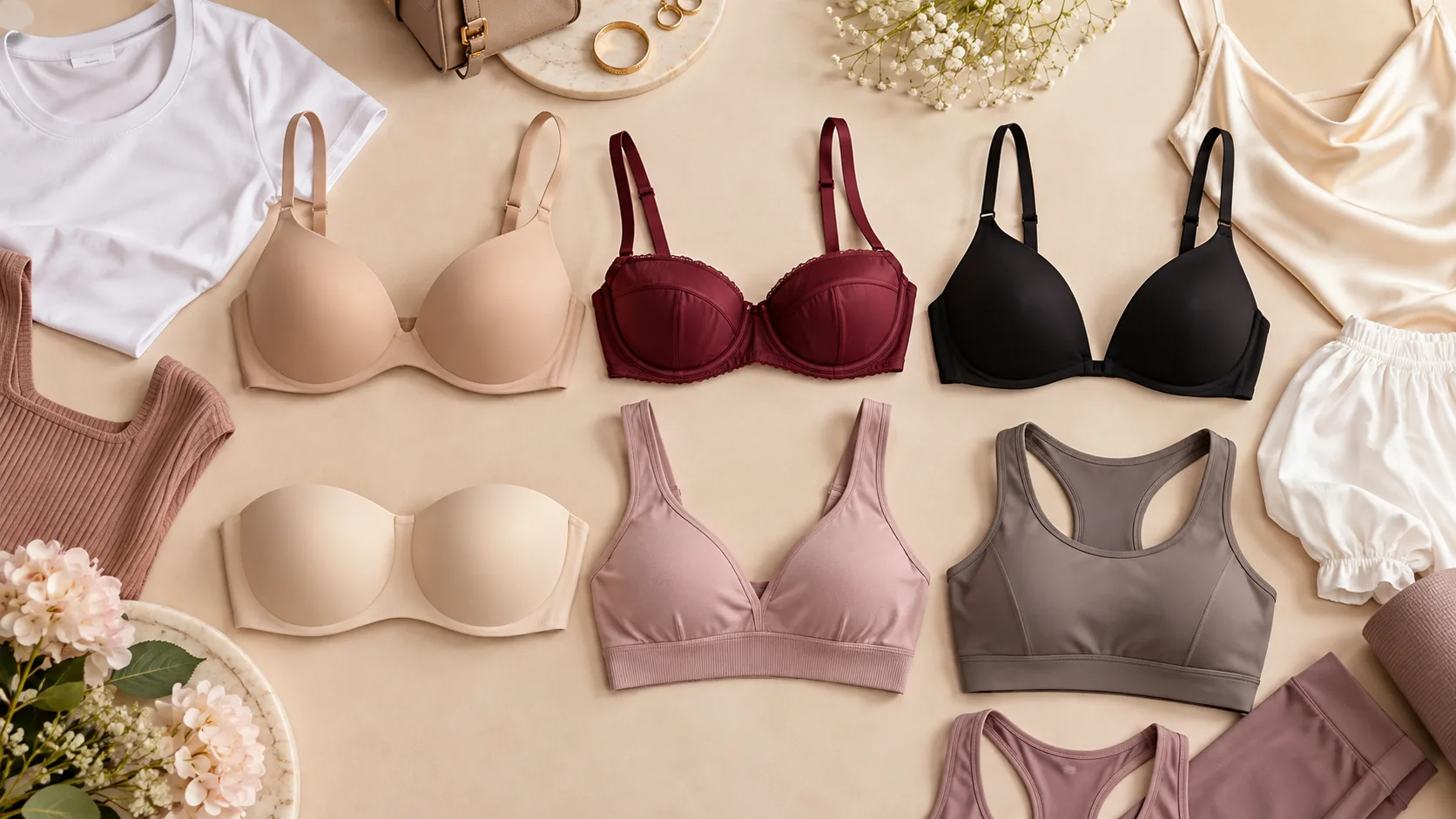
A T-shirt bra is made to disappear under fitted clothes. A plunge bra solves a low-neckline problem. A balconette changes how much of the upper cup is covered. A strapless bra is built around band support, while a sports bra has a completely different job altogether.
That’s why learning the main types of bra styles is more useful than simply collecting names.
The right bra often depends on the outfit first.
A smooth knit top may show lace or seams that wouldn’t matter under a cotton shirt. A square neckline might expose the edge of a full-coverage cup. A deep V-neck can require a lower centre, while an off-shoulder dress takes straps out of the equation entirely.
And sometimes the choice has nothing to do with hiding the bra. A bralette can be deliberately visible under an open shirt, while a wireless style may simply be what you prefer for a long, relaxed day.
The fifteen bra styles below cover the most useful categories to know, what makes each one different, and the kinds of clothes they tend to work best with.
Because the most useful question isn’t:
“Which bra style is the best?”
It’s:
“What do I need this bra to do under what I’m wearing?”
1. T-Shirt Bra
 Pin it
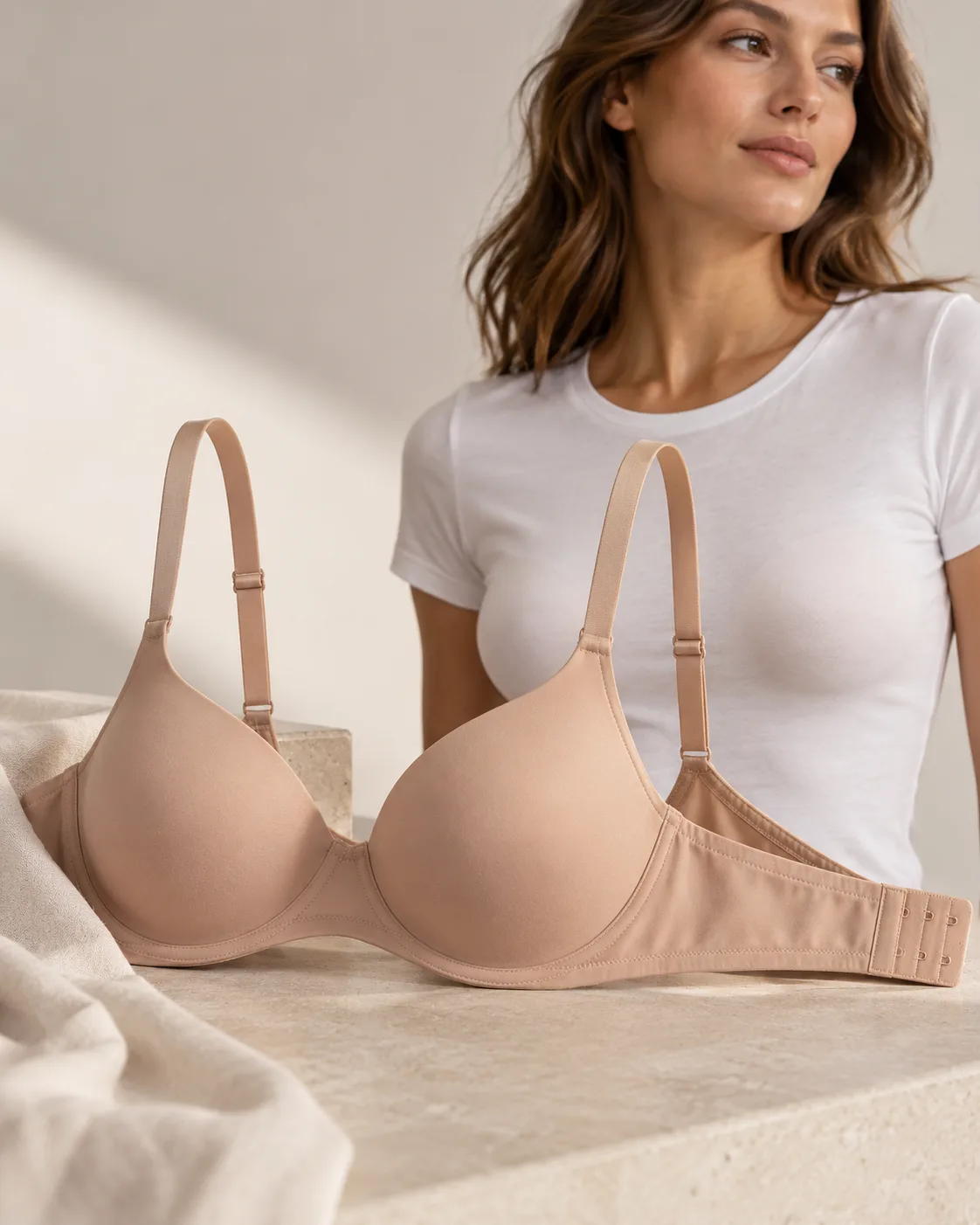
A T-shirt bra is designed to be as invisible as possible under clothes.
The cups are usually smooth, seamless, or lightly moulded, which helps reduce visible lines under fitted tops and thin fabrics. That makes it one of the easiest everyday bra styles to wear with clothing that sits close to the body.
It works especially well under:
fitted T-shirts
fine-knit tops
button-down shirts
simple dresses
lightweight blouses
What makes this style useful is not that it creates a dramatic shape. It’s that it doesn’t distract from the outfit.
If you’re wearing a thin white T-shirt, for example, a smooth bra close to your skin tone will usually disappear more cleanly than one with lace, heavy seams, or strong texture.
One thing to remember is that “T-shirt bra” describes the finish and construction more than a single cup shape. Some are fuller coverage, while others are lower-cut.
So if you’re comparing different types of bra styles, think of this one as the reliable base layer: smooth, practical, and designed to stay visually quiet under everyday clothes.
2. Full-Coverage Bra
 Pin it
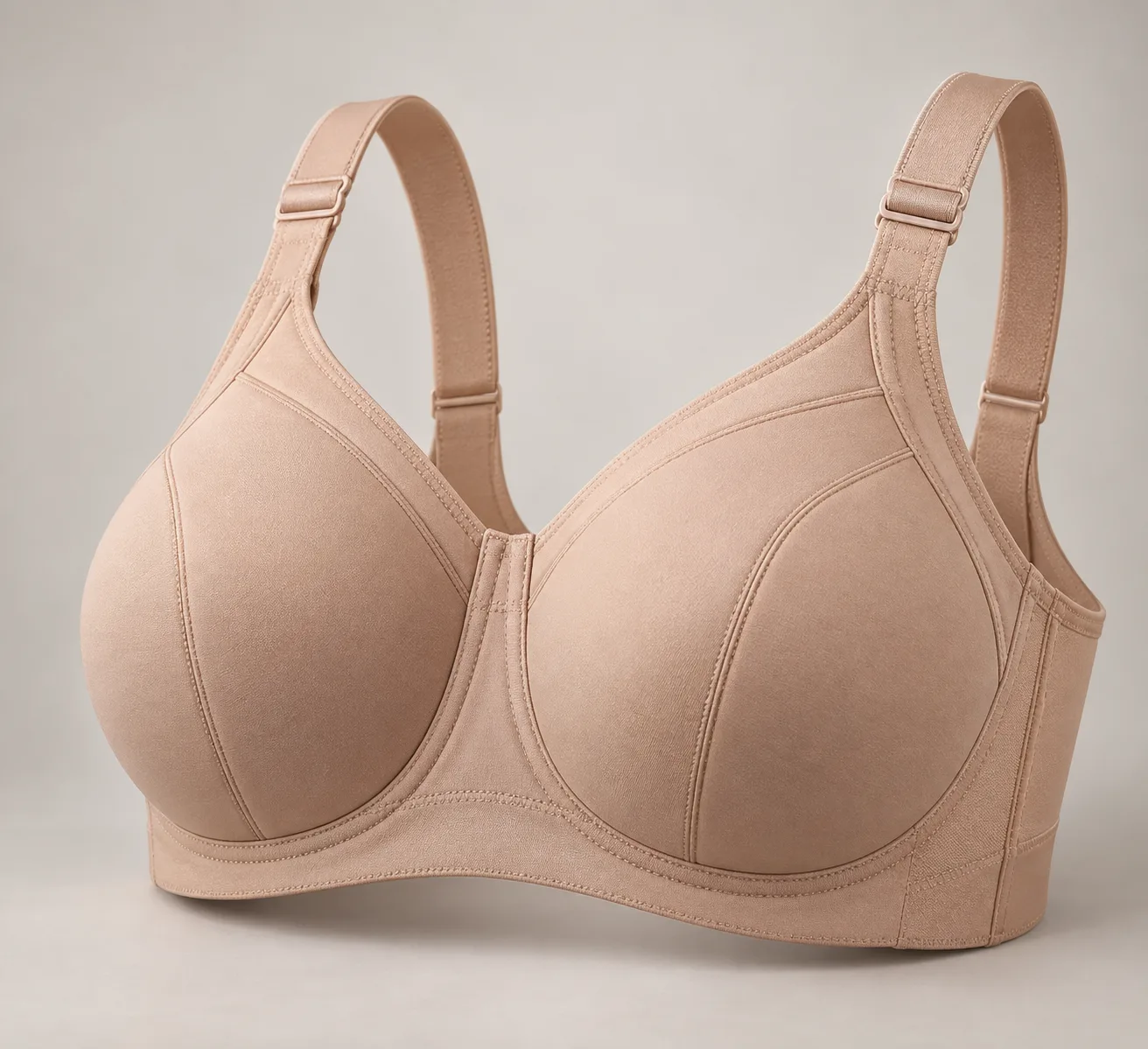
A full-coverage bra is designed to cover more of the breast than lower-cut styles such as demi or balconette bras.
The cups usually extend higher across the bust and may also have wider side panels, which can create a more contained, secure feel for everyday wear.
It works particularly well under:
higher-neck tops
work shirts
sweaters
relaxed dresses
everyday kurtas and blouses
What this style does best is coverage.
If you prefer a bra that feels less likely to shift throughout the day, or you simply like having more of the bust enclosed by the cup, this is often one of the most straightforward options.
It’s also worth separating full coverage from T-shirt bra, because the two terms describe different things.
A full-coverage bra refers mainly to how much of the bust the cup covers.
A T-shirt bra refers more to the smooth finish designed to stay discreet under clothing.
A bra can actually be both.
The main limitation is neckline compatibility. Because the cups often sit higher, a full-coverage bra may show under low scoop, square, or deep V-neck tops.
So among the different types of bras, this is less about adapting to tricky necklines and more about choosing reliable coverage for clothes that give the bra enough room to stay hidden.
3. Balconette Bra
 Pin it
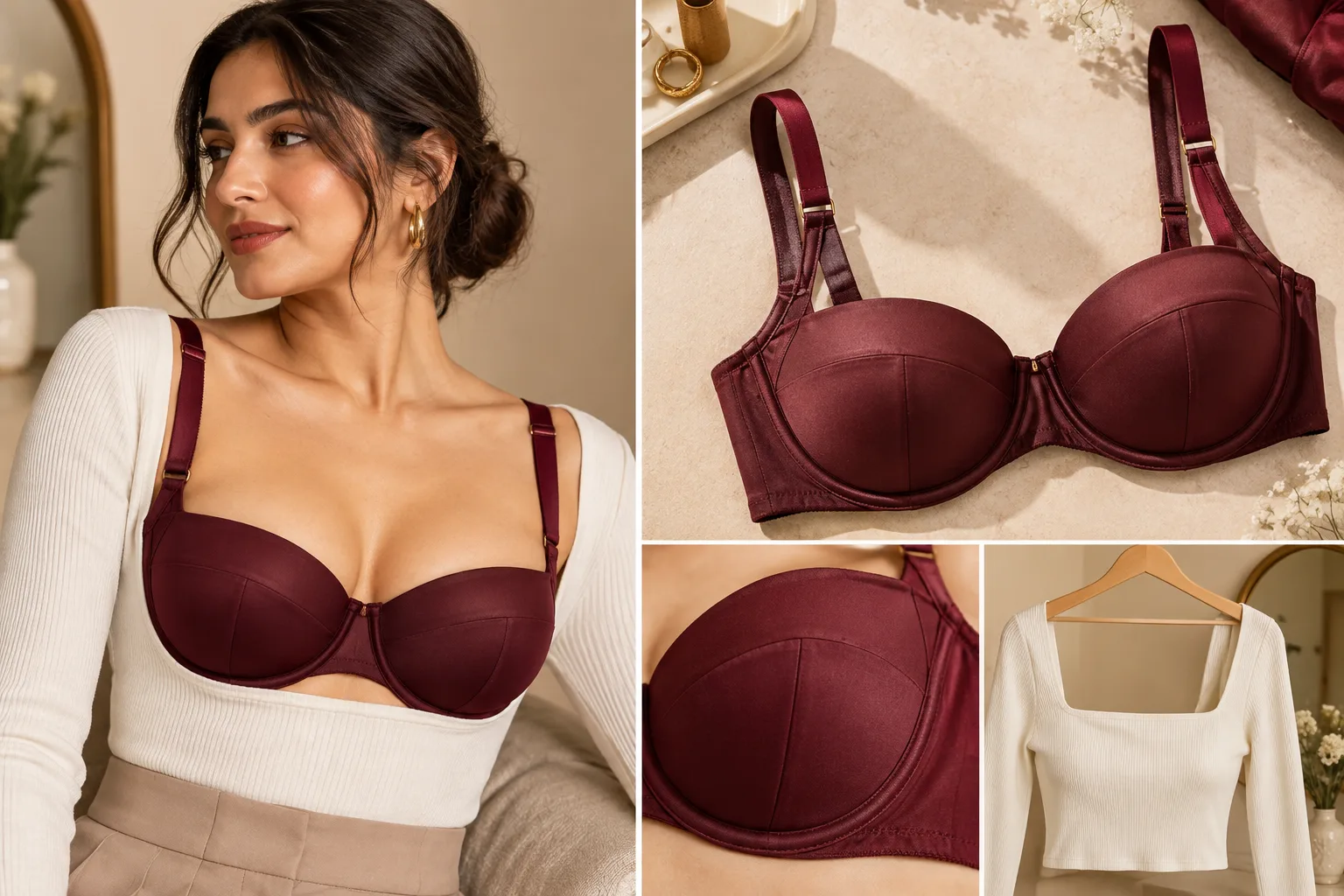
A balconette bra usually has a lower, more horizontal cup line with straps positioned wider apart than on many everyday bras.
That makes it especially useful when the neckline of your outfit is wider or more open across the chest.
It tends to work well under:
square-neck tops
wide scoop necks
certain fitted dresses
structured blouses
some off-shoulder-inspired necklines
The main thing to notice is the shape of the top edge.
Because the cups sit lower and more horizontally, they’re often less likely to peek out of a wide neckline than a full-coverage bra would be.
This is also why balconette bras are sometimes confused with demi bras. The two can overlap, but they’re not exactly the same.
A balconette is usually defined more by its wide-set straps and horizontal neckline, while a demi bra is more about reduced cup coverage.
Depending on the design, a balconette can feel more structured or more decorative, but the styling value stays the same: it works particularly well when your clothes expose more of the upper chest.
So if you’re comparing different types of bra styles, think of the balconette as the one that works with the shape of the neckline rather than simply disappearing underneath it.
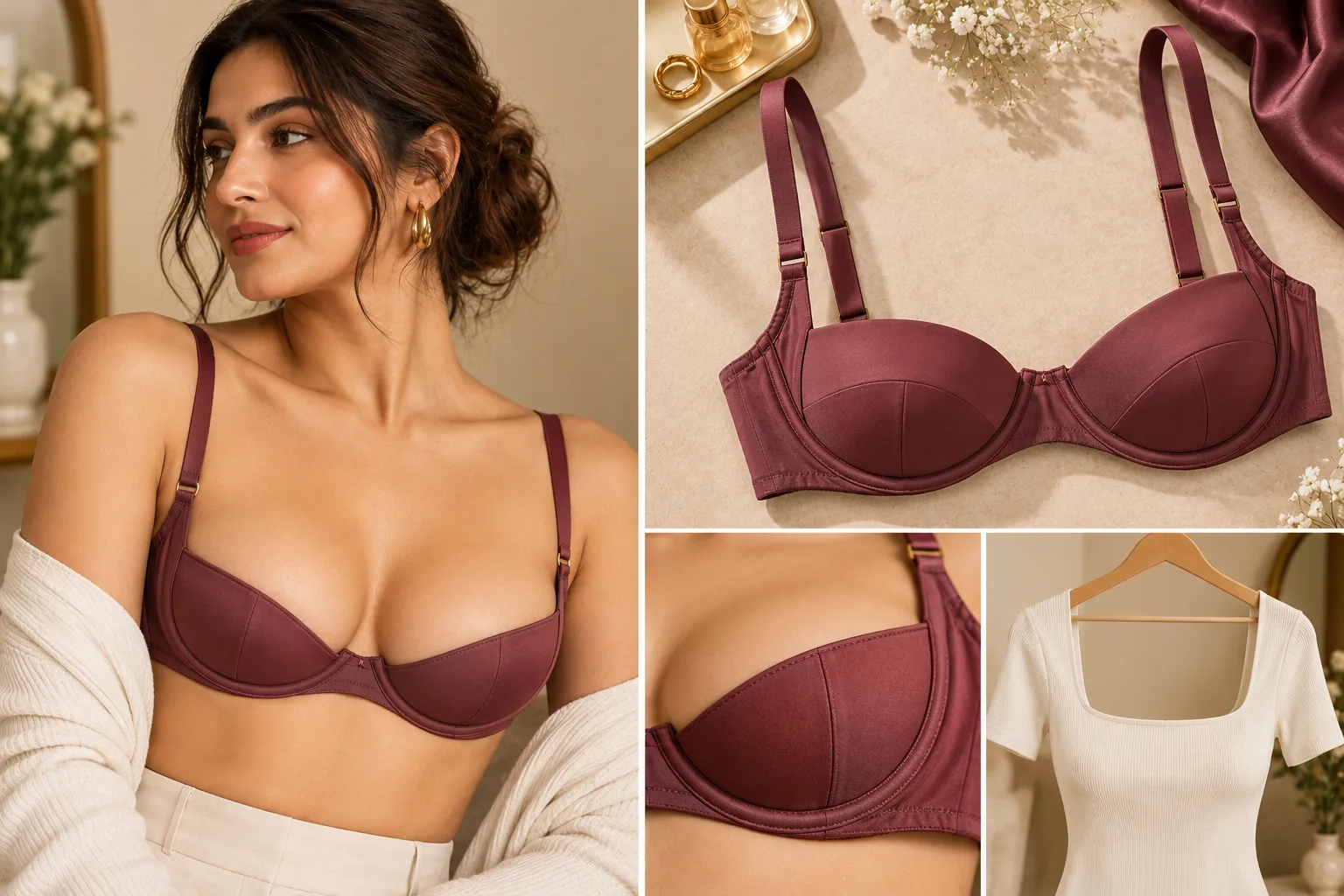
4. Demi-Cup Bra
 Pin it
A demi-cup bra gives less coverage than a full-cup style, usually covering around the lower half to three-quarters of the breast depending on the design.
That lower cup line makes it useful under clothes with more open necklines.
It tends to work well with:
lower scoop-neck tops
square-neck dresses
fitted blouses
evening tops
some sweetheart necklines
The easiest way to understand a demi bra is to think about cup coverage.
It doesn’t necessarily have the very wide-set straps of a balconette, and it doesn’t need the deep centre of a plunge bra. Its defining feature is simply that the cup finishes lower on the bust.
That makes it a useful middle ground when a full-coverage bra feels too high but a plunge style would be unnecessary.
Among the different types of bras, this is also one of the categories where product names can overlap. Some balconette bras are demi coverage, and some demi bras have a balconette-like neckline.
So rather than relying only on the label, look at the actual cup shape and where the top edge sits.
For styling, the important question is simple:
Will the bra stay below the neckline of the outfit?
If yes, a demi-cup bra can be one of the cleanest options for more open tops without moving into a much lower-cut plunge style.
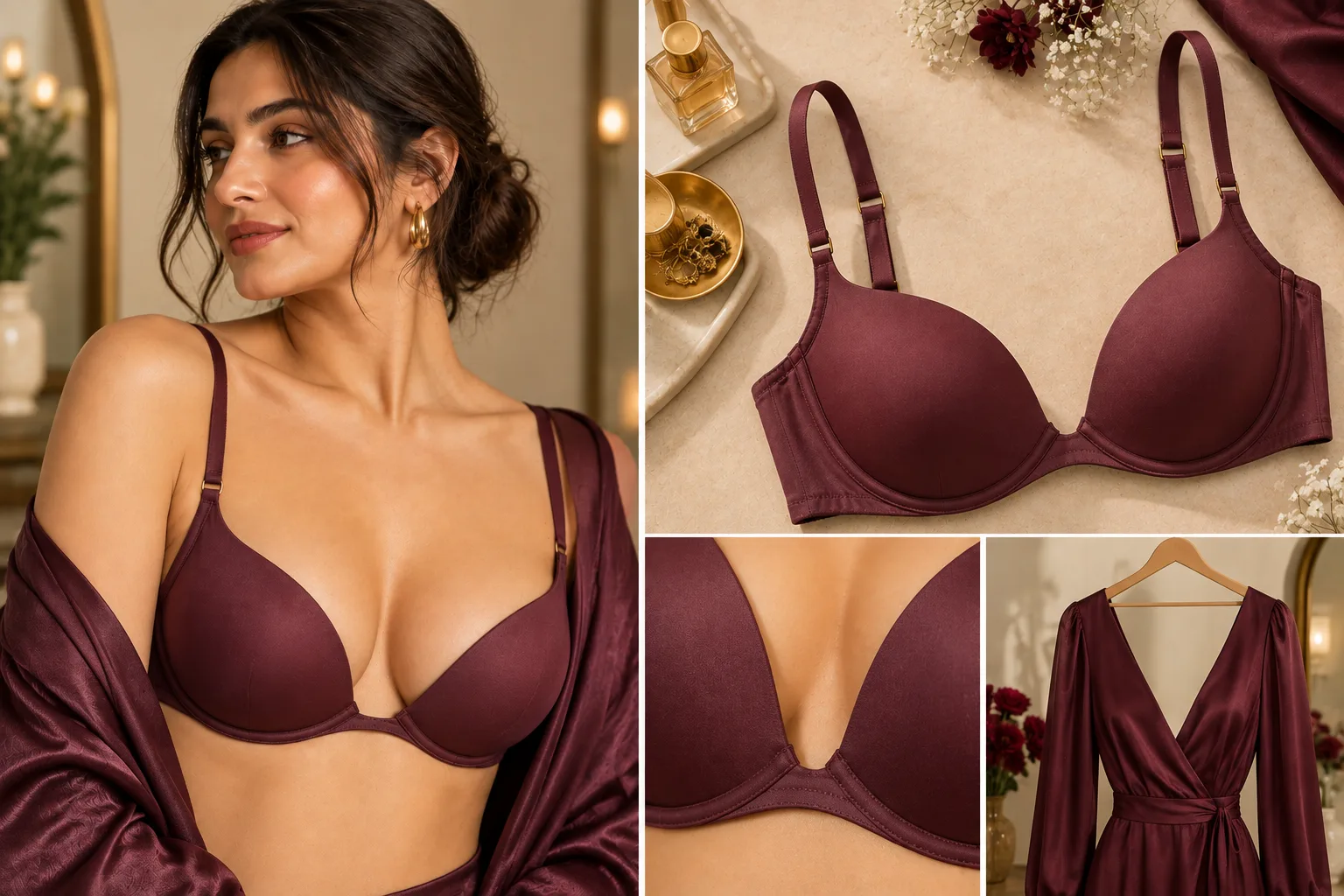
5. Plunge Bra
 Pin it
A plunge bra is designed with a low centre between the cups, which makes it especially useful under deep V-necklines.
That low centre is what sets it apart from many other bra styles.
It works particularly well under:
deep V-neck tops
wrap dresses
lower-cut blouses
evening dresses
some crossover necklines
A plunge bra doesn’t automatically mean heavy padding or dramatic cleavage.
Some styles are lightly lined, some are unlined, and some are more structured. The important feature is that the centre gore sits lower, so it is less likely to show when the neckline drops in the middle.
That also makes it different from a demi bra.
A demi bra reduces how much of the cup covers the bust, while a plunge bra is specifically designed around a lower centre front.
You can sometimes find bras that combine both features, but they solve slightly different wardrobe problems.
If you’re comparing different types of bra styles for occasionwear, the plunge is one of the most useful to understand because it can make a low neckline much easier to wear without changing the shape of the outfit.
The simplest way to remember it is:
low neckline in the centre = look for a lower centre in the bra.
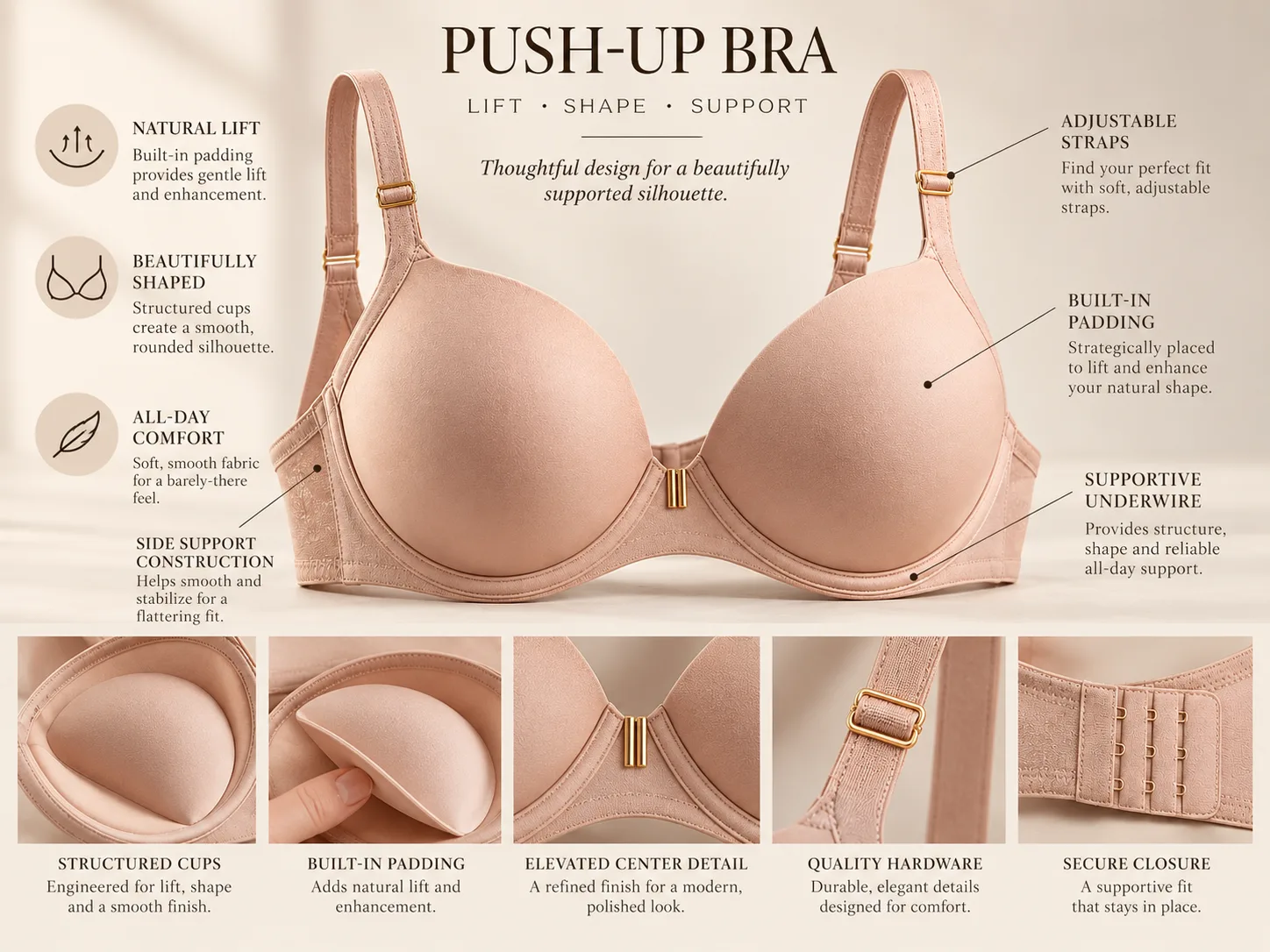
6. Push-Up Bra
 Pin it
A push-up bra is designed to lift the breasts and bring them closer together using cup construction, padding, or both.
The effect can range from subtle to quite noticeable depending on the style.
It often works well under:
fitted evening tops
lower necklines
body-skimming dresses
certain party tops
outfits where you specifically want a more lifted or centred shape
The important thing is that a push-up bra describes the effect, not one specific neckline.
You can find push-up bras with plunge cups, demi cups, or other constructions, which is why it can overlap with several other types of bra styles.
For example, a plunge bra is defined mainly by its low centre. A push-up bra is defined by how the cups position the breasts. One bra can easily be both.
Padding also varies. Some push-up styles use removable inserts, some place more padding toward the bottom or sides of the cup, and others create lift mostly through the shape of the bra itself.
That gives you room to choose how noticeable you want the effect to be.
I’d treat this style as an outfit-specific option rather than an everyday requirement.
If the neckline and silhouette already look the way you want with a regular bra, there’s no reason to add push-up construction simply because the outfit is dressy.
The useful question is:
Do I want a more lifted or centred shape under this particular outfit?
If the answer is yes, that’s where a push-up bra earns its place.
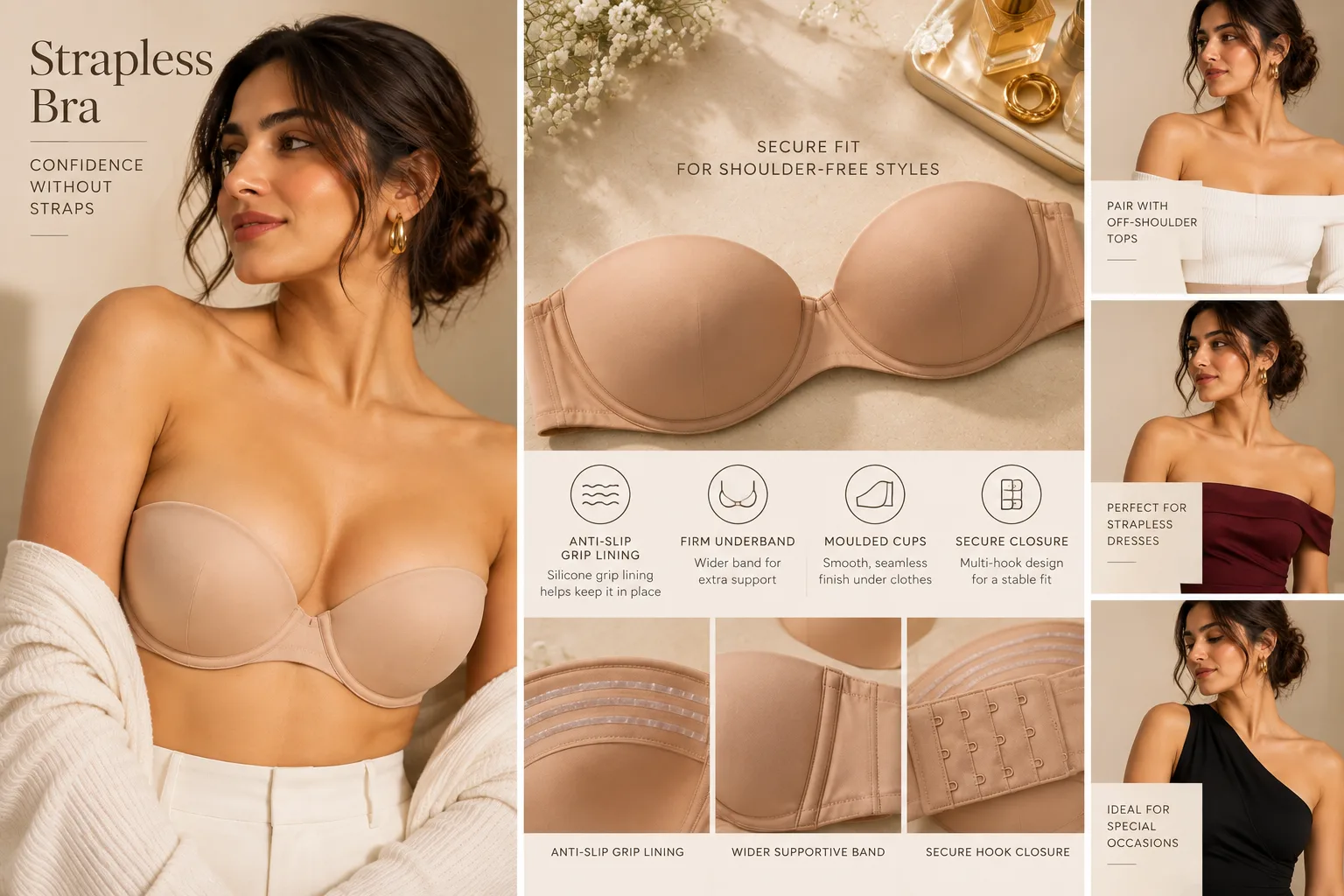
7. Strapless Bra
 Pin it
A strapless bra is designed to stay in place without relying on shoulder straps.
That means the band has to do much more of the work.
It usually works best under:
strapless dresses
off-shoulder tops
tube tops
certain asymmetric necklines
occasionwear with exposed shoulders
Many strapless bras use a firmer band, gripper strips, side support, or more structured cups to help keep the bra from sliding down.
That’s why fit matters so much with this style.
If the band is too loose, you may spend the evening pulling it back into place. If it’s excessively tight, the bra can become uncomfortable long before the outfit does.
Among the different types of bras, this is one where I’d pay more attention to the band than to padding or decoration.
Also, don’t assume every strapless bra has to be heavily padded. You can find smoother, lightly lined, moulded, and more structured options depending on what you want underneath the outfit.
The neckline matters too. Some strapless bras sit relatively high, while others have a lower centre for dresses with a deeper front.
If you regularly wear off-shoulder or strapless clothing, this is one of the few bra styles that solves a very specific wardrobe problem.
The easiest test is simple:
once it’s on, you shouldn’t have to keep thinking about it.
8. Multiway or Convertible Bra
 Pin it
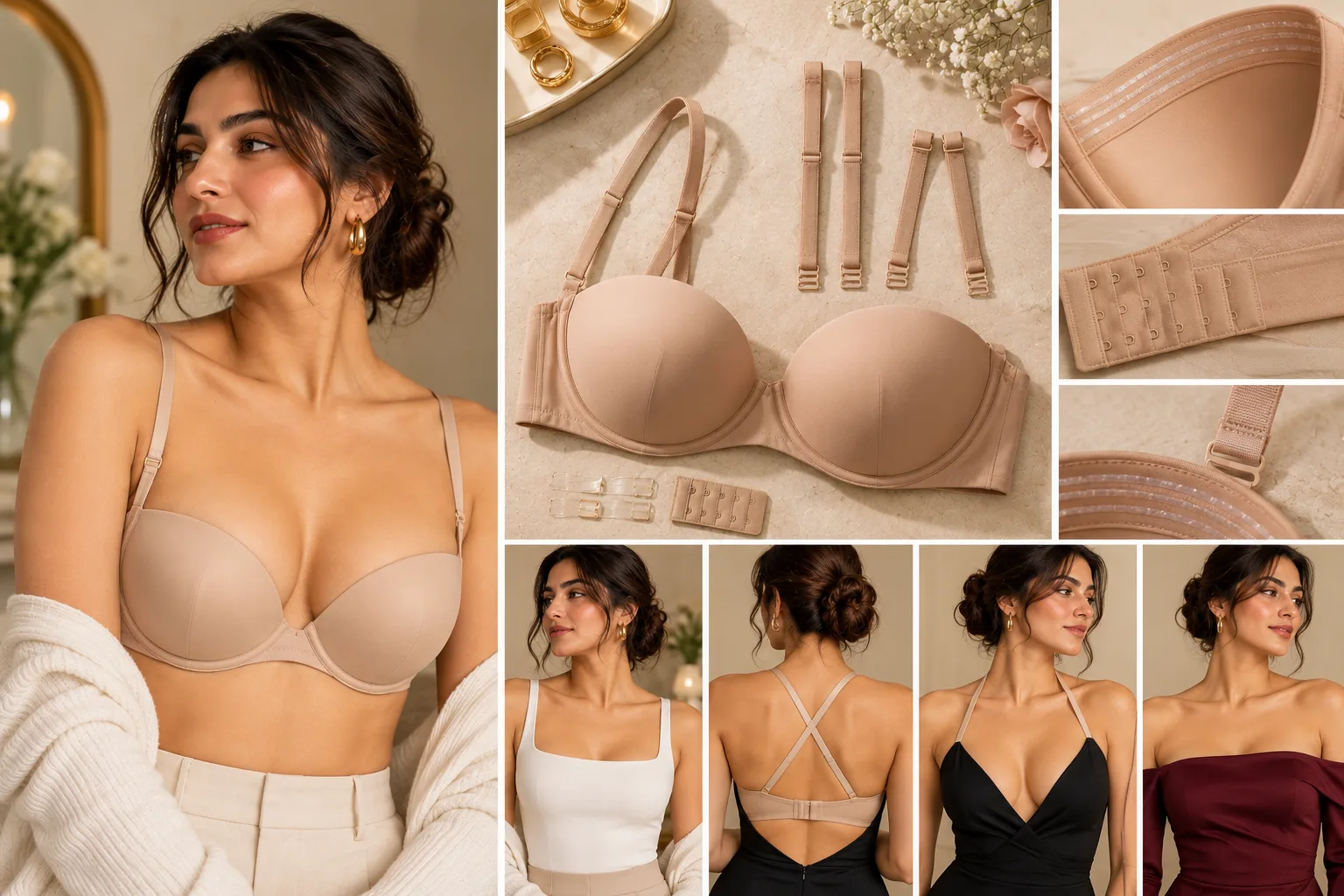
A multiway bra is designed to adapt to different outfits by changing the way the straps are worn.
Depending on the bra, you may be able to wear the straps:
normally
crossed at the back
halter-style
one-shoulder
or completely removed
That flexibility makes it especially useful under:
racerback tops
halter-neck dresses
asymmetric necklines
some off-shoulder outfits
occasionwear with unusual straps
What makes this style different from a standard strapless bra is versatility.
A strapless bra is mainly designed to work without straps. A convertible bra gives you several configurations, so the same piece can solve more than one wardrobe problem.
This can be useful if you don’t want to own a separate bra for every tricky neckline.
That said, it’s worth checking how the straps actually attach before buying. Some designs offer far more configurations than others, and the placement of the attachment points can affect which outfits they genuinely work with.
If you wear a lot of modern dresses or tops with unusual shoulder details, this is one of the more practical types of bra styles to have in your wardrobe.
Think of it less as one specific silhouette and more as a bra that can change its setup depending on what you’re wearing.
9. Wireless Bra
 Pin it
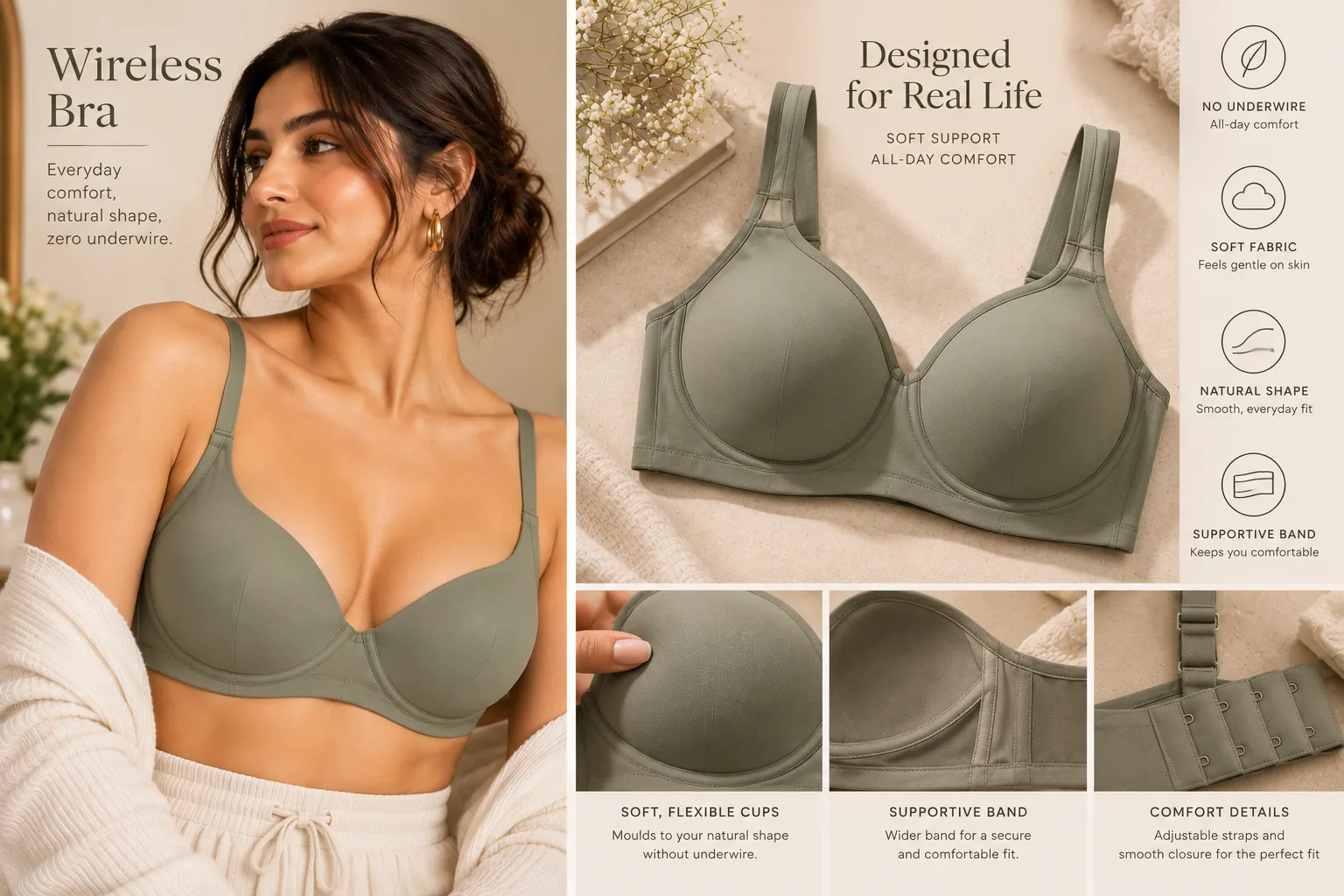
A wireless bra is exactly what it sounds like: a bra without an underwire.
Instead of relying on wire beneath the cups, the shape and support come from the band, fabric, cup construction, seams, and overall fit.
It can work well for:
everyday wear
long workdays
travel
relaxed weekends
loose shirts and knitwear
outfits where comfort matters more than a highly structured shape
One thing I wouldn’t assume is that wireless automatically means unsupportive.
Some wireless bras are extremely soft and lightly structured, while others use firmer bands, shaped cups, wider straps, or reinforced panels to provide much more support.
That means two wireless bras can feel completely different even though they sit in the same category.
This style also overlaps with several other types of bras. You can find wireless T-shirt bras, wireless full-coverage bras, wireless plunge designs, and even wireless sports bras.
So “wireless” tells you what the bra doesn’t contain, not necessarily what the cup shape will look like.
For everyday styling, I’d choose it based on the clothes you’re wearing. A smooth wireless bra can disappear neatly under a T-shirt, while a softer unlined version may work better beneath relaxed shirts and looser layers.
The real question is less:
“Is wireless better?” and more: “Does this particular wireless bra give me the comfort, shape, and coverage I want under this outfit?”
10. Bralette
 Pin it
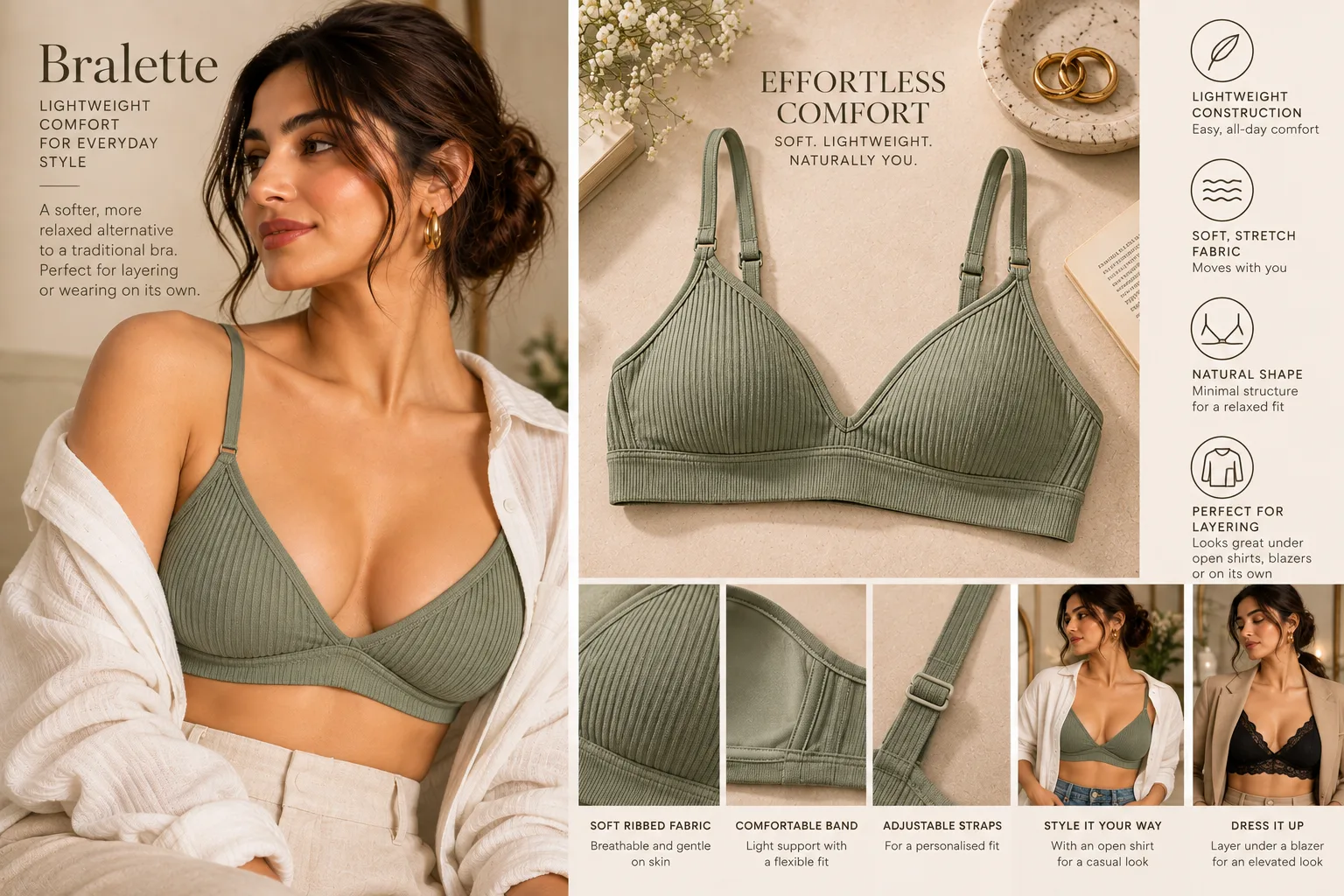
A bralette is usually lighter and less structured than a traditional bra, although the amount of support can vary a lot depending on the design.
Some are soft pull-on styles with very little shaping. Others use wider bands, lined cups, adjustable straps, or more substantial fabric to give a little more structure.
It often works well with:
oversized shirts
loose knits
relaxed dresses
layered outfits
at-home dressing
casual looks where the bra may be intentionally visible
This is one of the few types of bra styles where showing a little of the bra can actually be part of the outfit.
A lace bralette under an open linen shirt, for example, creates a completely different effect from a T-shirt bra that is meant to disappear. The same goes for a clean ribbed bralette under an oversized blazer or relaxed button-down.
That doesn’t mean every bralette is designed to be shown, though. Some are simply comfortable base layers.
I’d also avoid treating bralettes as automatically suitable for everyone in exactly the same way. Support levels differ enormously between designs, so the right one depends on what feels comfortable and secure for you.
The easiest way to think about a bralette is this:
it prioritises softness and simplicity, and sometimes turns the bra itself into part of the styling.
11. Sports Bra
 Pin it
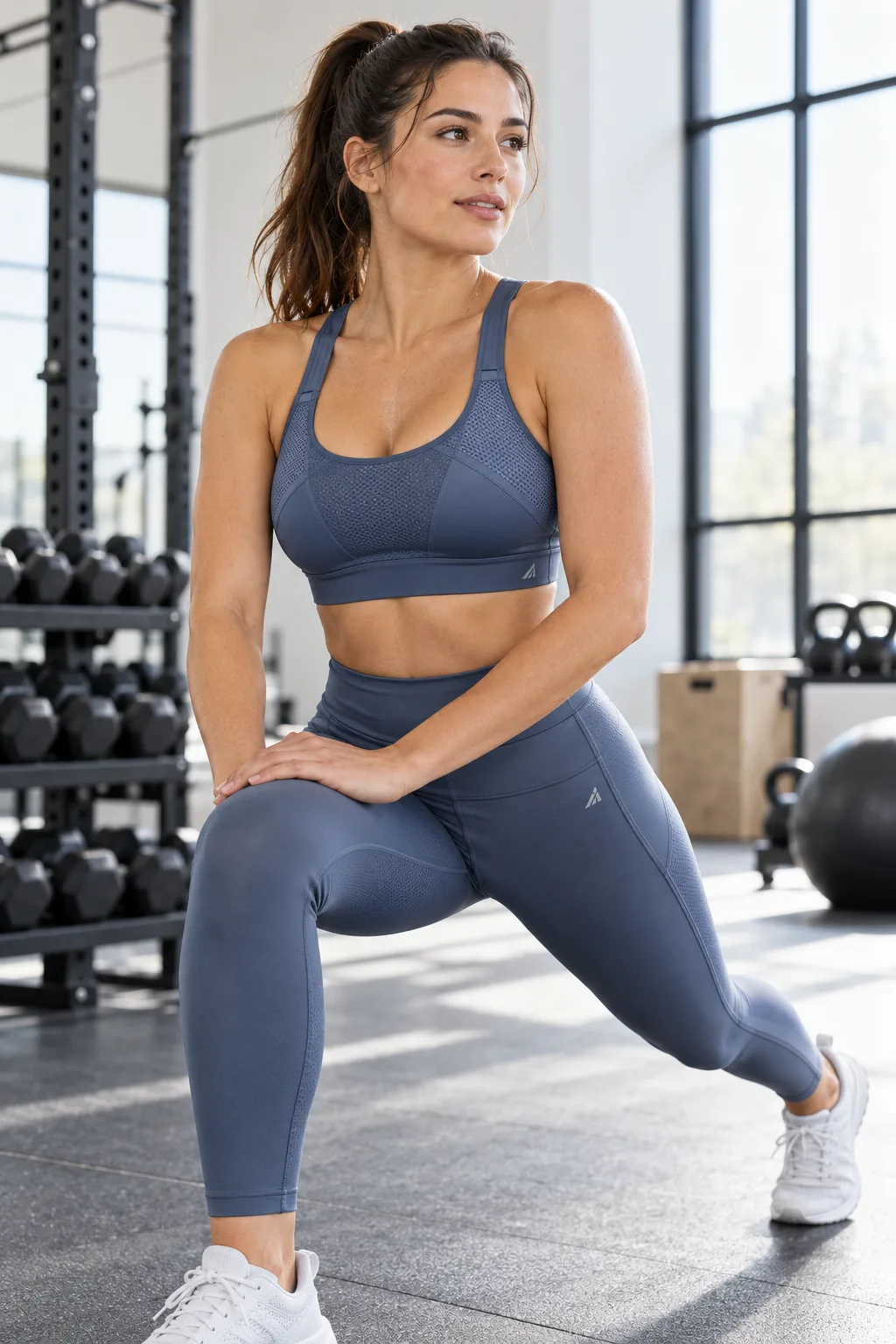
A sports bra is designed for movement rather than everyday styling alone.
Its main job is to reduce breast movement during exercise, which is why the construction usually feels more secure than a standard bra.
Depending on the design, a sports bra may work through:
compression, which holds the breasts closer to the chest
encapsulation, where each breast is supported more individually
or a combination of both
It’s useful for:
running
gym workouts
strength training
yoga
cycling
dance
active days
Not every sports bra is meant for the same level of activity.
A softer, lighter style may feel completely comfortable for yoga or walking, while running or higher-impact training often calls for a more secure construction.
That makes “sports bra” one of the broader types of bra styles in this guide rather than one single shape.
The neckline, straps, and closure can vary too. Some have racerbacks, some use adjustable straps, some close at the back, and others are pull-on styles.
For outfits, I’d treat this one differently from the rest of the list.
You’re not primarily choosing it based on whether it disappears under a neckline. You’re choosing it based on what you’ll actually be doing while wearing it.
A sports bra may also become part of the outfit itself under a zip jacket, oversized shirt, or workout layer.
The useful question here is:
What level of movement does this bra need to handle?
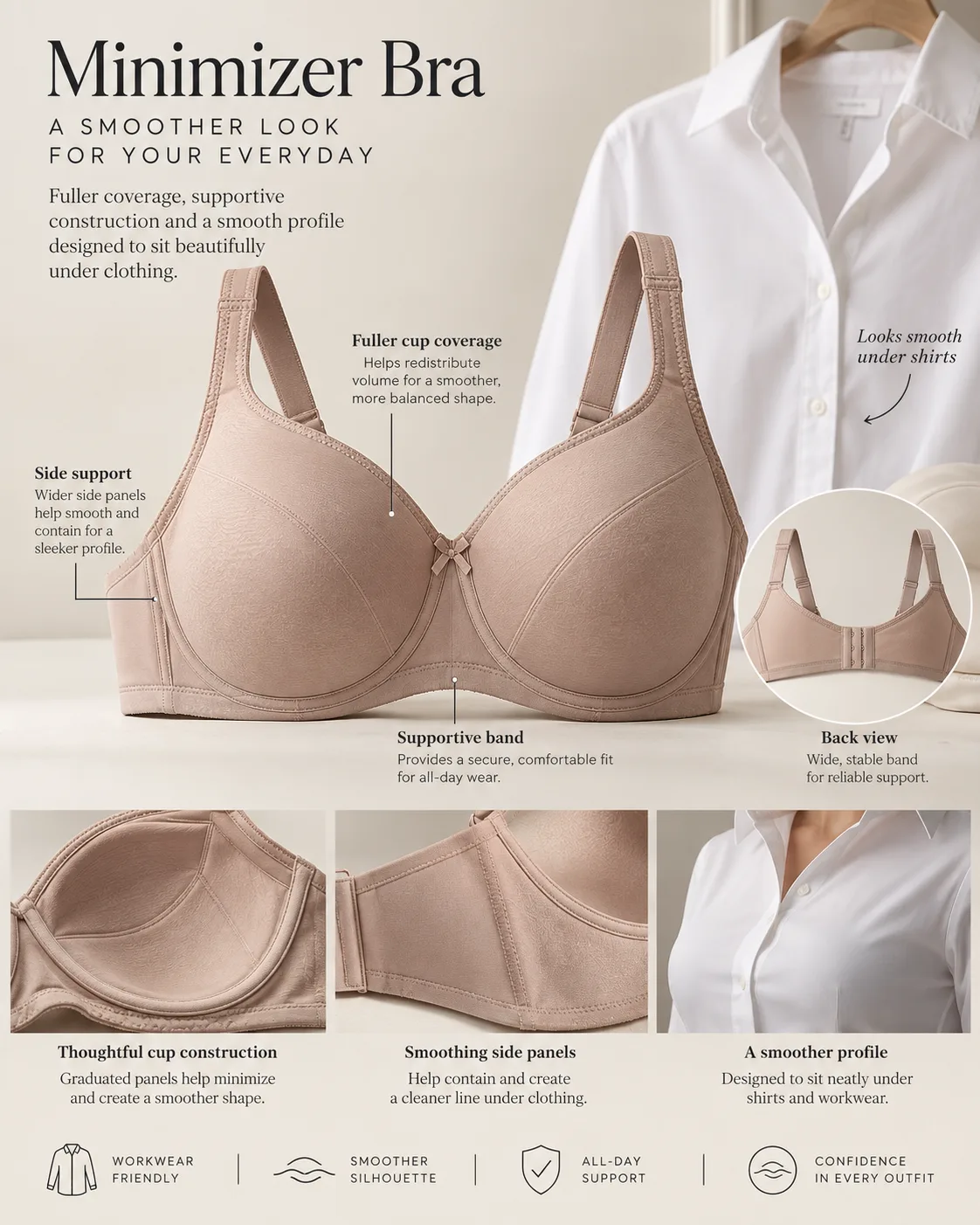
12. Minimizer Bra
 Pin it
A minimizer bra is designed to redistribute breast tissue so the bust can appear less projected under clothing.
It doesn’t literally make the breasts smaller.
Instead, the cup construction usually spreads the breast tissue more evenly across the chest, which can create a smoother line under certain outfits.
It can be especially useful under:
button-down shirts
structured blouses
fitted kurtas
tailored dresses
workwear
tops that tend to pull across the bust
This is one of those types of bras that solves a very specific clothing problem.
For example, if a shirt fits well everywhere else but the buttons strain across the chest, a minimizer may help the fabric sit more smoothly without changing the rest of the outfit.
I’d pay attention to the side profile when trying one on. Some styles reduce forward projection more noticeably than others, and the shape can vary depending on how the cups are constructed.
It’s also worth separating a minimizer from a compression-style sports bra. Both may make the bust look less projected, but they are designed for very different purposes.
A minimizer is primarily about how clothing sits.
The simplest way to think about it is:
if the goal is a smoother, less projected silhouette under structured clothes, this is the bra style to look at.
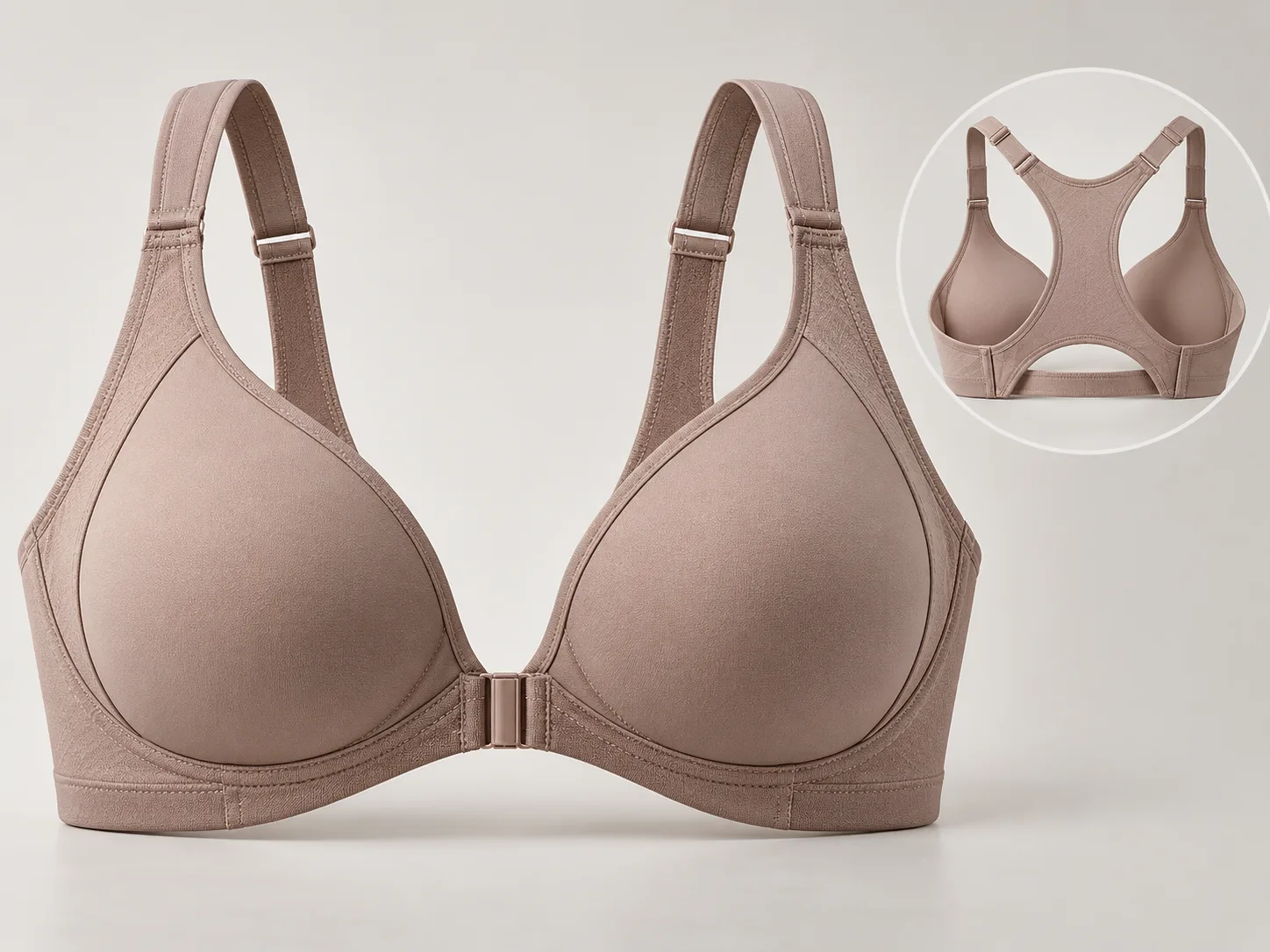
13. Front-Closure Bra
 Pin it
A front-closure bra fastens at the centre of the chest instead of at the back.
That may sound like a small design difference, but it can change how the bra feels to put on and how the back looks under certain clothes.
It can work well with:
racerback tops
fitted shirts
dresses where you want a smoother back
everyday outfits where front fastening simply feels more convenient
The important thing is that front closure does not describe the cup shape.
A front-fastening bra can still be full coverage, plunge, wireless, padded, or lightly lined. The defining feature is simply where the closure sits.
Some versions also use a racerback or narrower back construction, which can work nicely under tops that expose more of the shoulder blades.
If you’re comparing different types of bra styles, this is a useful example of how the categories can overlap. One bra can easily belong to several types at once.
The styling advantage is practical rather than dramatic.
You’re choosing it because the fastening, back shape, or ease of wear works better for you — not because it creates one specific neckline or silhouette.
Think of it as a construction choice first, and a styling choice second.
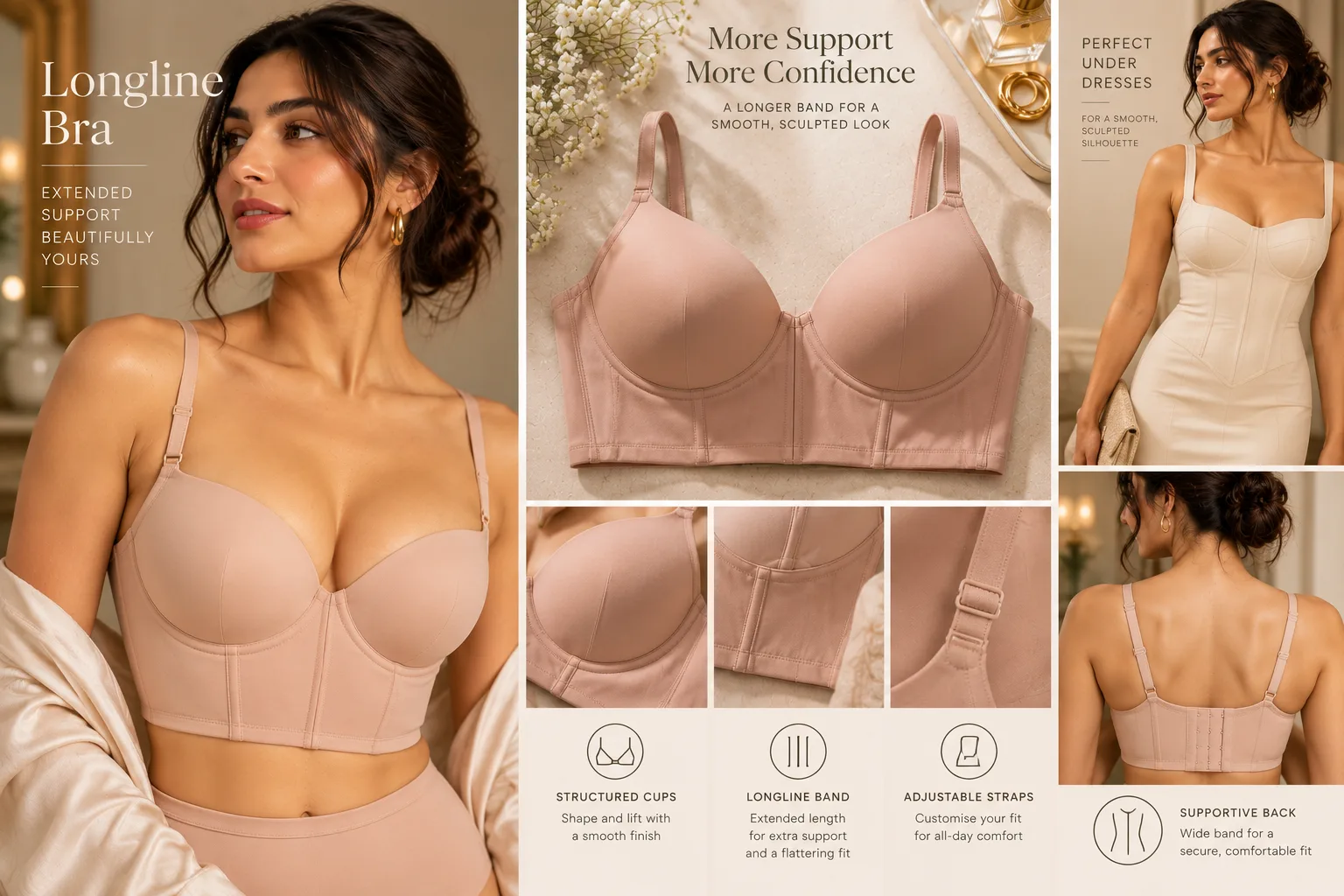
14. Longline Bra
 Pin it
A longline bra extends farther down the torso than a standard bra, sometimes by just a few centimetres and sometimes much farther toward the waist.
That extra length can make the bra feel more anchored and can create a smoother transition beneath certain fitted outfits.
It can work well under:
structured dresses
fitted occasionwear
some saree blouses
corset-inspired tops
outfits where a standard narrow band feels too abrupt
Longline bras come in several different versions.
Some are lightly structured and designed mainly for comfort and support. Others are more decorative or corset-inspired. You can also find longline styles with underwire, without wire, with padding, or with softer cups.
So among the different types of bra styles, “longline” describes the extended band rather than one specific cup shape.
It’s also worth separating a longline bra from shapewear.
The extra fabric may create a smoother look under clothing, but not every longline bra is designed to compress or reshape the waist. If that is what you want, you need to look at the actual construction rather than assuming the longer band will do it automatically.
For styling, this type can be especially useful when the outfit itself is structured and you want the bra to feel like part of that foundation.
The easiest way to recognise it is simple:
a standard bra stops at the underband; a longline bra keeps going.
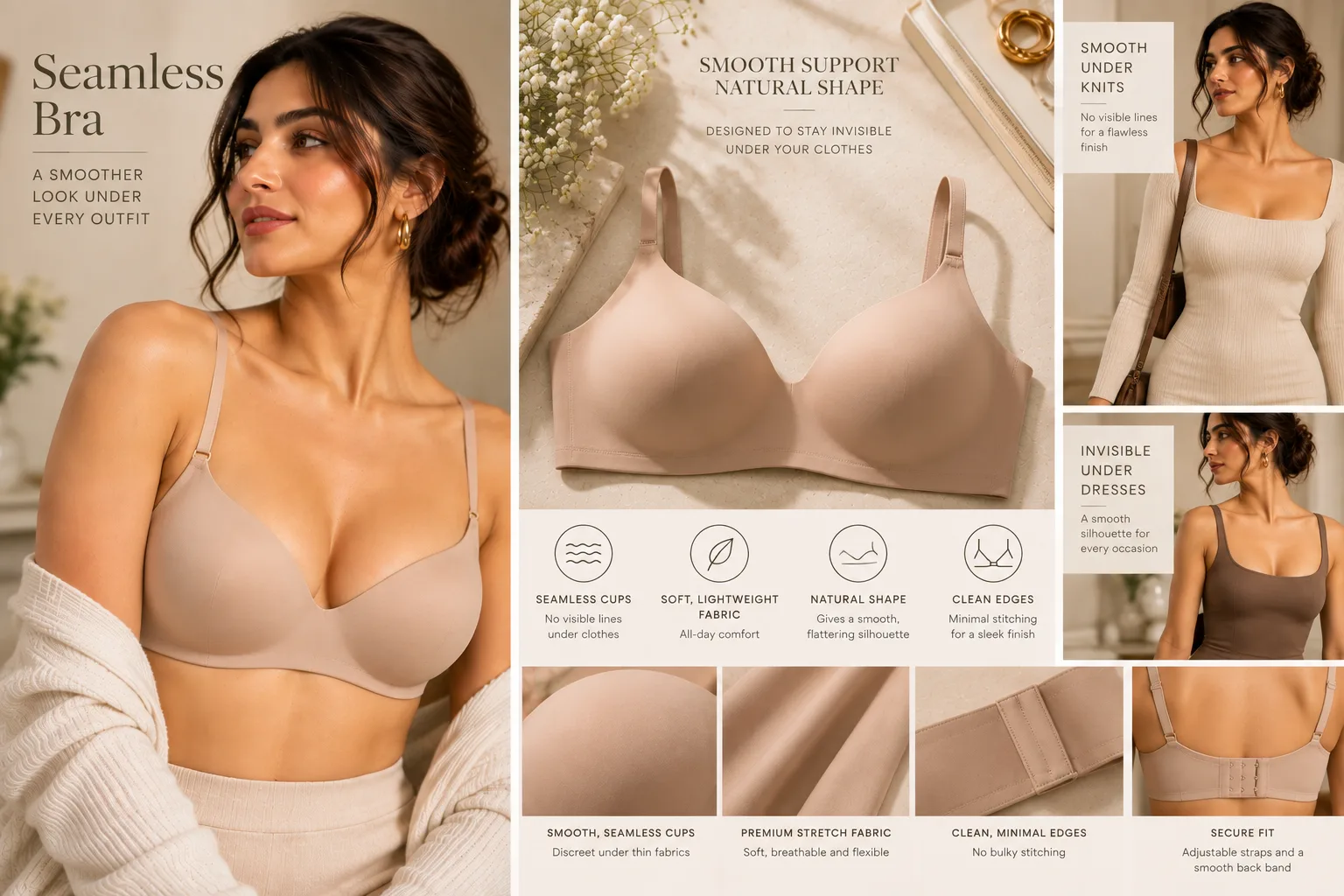
15. Seamless Bra
 Pin it
A seamless bra is designed with minimal visible stitching, seams, or textured construction across the cups.
That makes it especially useful under clothes where even small lines can show.
It tends to work well under:
thin T-shirts
fitted knitwear
body-skimming dresses
lightweight blouses
smooth stretch fabrics
At first glance, this can sound almost identical to a T-shirt bra, but there is a small difference.
A T-shirt bra is generally designed specifically to create a smooth, invisible finish under fitted clothes and often uses moulded cups.
A seamless bra simply means the construction has fewer seams or visible joins. It may be moulded, lightly lined, wireless, or built in a softer way.
So one bra can be both seamless and a T-shirt bra, but the two terms are not automatically interchangeable.
This is another good example of why different types of bra styles sometimes overlap rather than fitting into perfectly separate categories.
For styling, the seamless option is especially useful when the fabric of the outfit is very unforgiving.
If a top shows every line underneath, smooth construction matters more than lace, embroidery, or decorative detailing.
The easiest rule is:
the thinner and more fitted the outer fabric, the quieter the bra underneath should be.
How Do You Choose the Right Bra Style?
Once you know the main types of bras, choosing between them gets much easier if you start with the clothes you’re actually wearing.
You don’t necessarily need a different bra for every outfit. What matters is understanding which details of the clothing are likely to expose, compress, or interact with the bra underneath.
Start With the Neckline
This is usually the quickest way to narrow things down.
A crew-neck T-shirt gives you plenty of coverage, so a T-shirt or seamless bra can work easily.
A square neckline may sit better over a balconette or demi style because the upper cup line is lower and wider.
A deep V-neck usually needs a plunge bra with a lower centre.
For strapless or off-shoulder clothing, the straps become the problem, which is where a strapless or convertible style makes more sense.
The bra should work with the shape of the neckline rather than constantly needing to be hidden.
Look at the Fabric Next
Thin fabrics reveal much more than heavier ones.
A lace bra may look completely fine under a denim shirt but create obvious texture beneath a fitted jersey top.
For:
thin knits
fitted T-shirts
smooth stretch dresses
lightweight blouses
a seamless or smooth-cup bra will usually create a cleaner finish.
With heavier fabric, embroidery, prints, or layering, you have far more freedom because small seams and texture are less noticeable.
Decide How Much Coverage You Actually Want
Not every outfit requires the lowest-cut bra possible.
If the neckline is high, you might prefer the security of a full-coverage style.
If the neckline is more open, a demi, balconette, or plunge design may fit underneath more easily.
This is personal as much as practical. Two people wearing the same dress may prefer completely different types of bra styles underneath it.
Think About What You’ll Be Doing
The bra that works for dinner may not be the one you want for a day of travel.
And neither of those should replace a proper sports bra when you’re exercising.
Think about:
how long you’ll wear it
how much you’ll move
whether you’ll be sitting for hours
whether you’ll be dancing
whether the outfit needs frequent adjustment
Comfort becomes much more noticeable after several hours.
Decide Whether the Bra Needs to Disappear
Sometimes that’s the whole objective.
Under a fitted T-shirt or simple evening dress, you may want the bra to be almost invisible.
But that isn’t always the rule.
A bralette under an open shirt, a visible strap with a relaxed layered outfit, or a fashion-led lingerie detail can be intentional.
So before trying to hide everything, ask whether the bra is meant to be invisible in the first place.
Finally, Check the Actual Fit
The style can be perfect for the outfit and still be the wrong bra if the fit is off.
The band should feel secure, the cups should sit properly, and the straps should stay in place without needing constant adjustment.
Bra labels are useful, but the name of the style only tells you so much.
Two balconette bras from different brands can fit very differently. The same is true of T-shirt bras, wireless bras, sports bras, and almost every other category.
That’s why the best approach is:
choose the bra style for the outfit, then choose the individual bra for the fit.
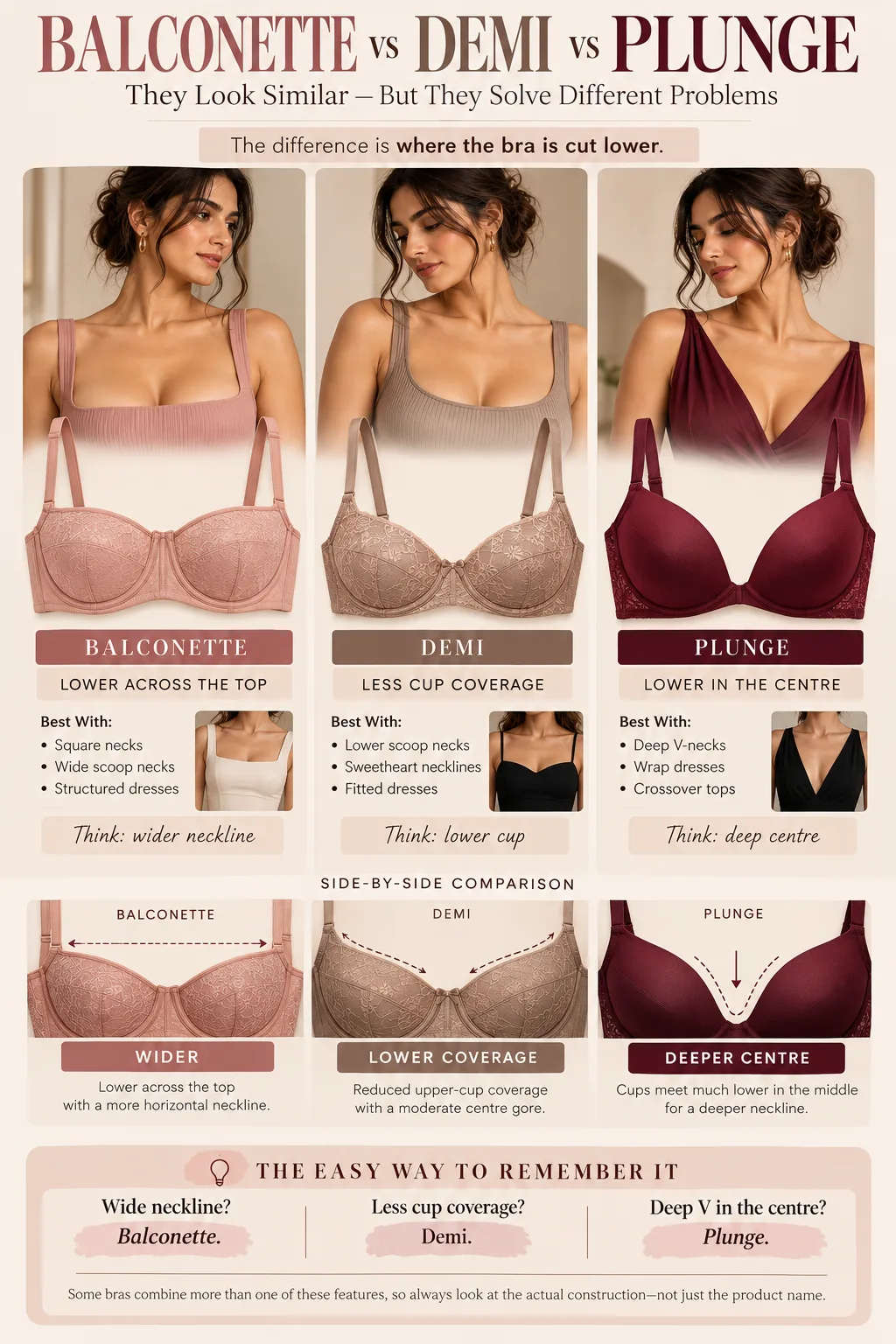
Balconette vs Demi vs Plunge: What’s the Difference?
 Pin it
These three types of bra styles often look similar at first glance because all of them can offer less coverage than a traditional full-cup bra.
The difference is really about where the bra is cut lower.
Balconette Bra
A balconette usually has a more horizontal neckline with straps positioned farther apart.
That makes it useful under:
square necklines
wide scoop necks
structured dresses
tops that expose more of the upper chest
Think of it as the bra that opens the neckline across the top.
Demi-Cup Bra
A demi bra is defined more by the amount of cup coverage.
The cup generally finishes lower across the bust than a full-coverage style, but the centre doesn’t necessarily plunge dramatically.
It can work well under:
lower scoop necks
sweetheart necklines
square-neck tops
fitted evening dresses
Think of this one as simply offering less cup above the bust.
Plunge Bra
A plunge bra is different because the lowest point is in the middle.
The centre between the cups drops much farther down, which creates space for:
deep V-necks
wrap dresses
crossover tops
low-cut eveningwear
Think:
deep neckline in the centre = plunge.
The Quickest Way to Tell Them Apart
If the outfit is wide across the neckline, look at a balconette.
If you simply need less cup coverage, consider a demi.
If the neckline drops deeply in the centre, a plunge is usually the more relevant style.
And remember that these categories can overlap.
You may find a balconette with demi coverage or a push-up bra with a plunge centre. Lingerie terminology describes different parts of the construction, so one bra doesn’t always fit neatly into only one category.
That’s why looking at the actual neckline of the bra is often more useful than relying on the product name alone.
Final Thoughts
Knowing the different types of bras is useful, but you don’t need every style in your wardrobe.
What matters more is understanding what each one is designed to do.
A T-shirt bra solves a smoothness problem. A balconette works with wider necklines. A plunge makes sense when the neckline drops in the centre. A strapless or convertible bra helps with exposed shoulders, while a sports bra is built around movement rather than outfit styling.
Once you start thinking that way, choosing between different types of bra styles becomes much simpler.
Look at the outfit first. Notice the neckline, fabric, straps, and how fitted it is. Then decide how much coverage, structure, or visibility you actually want underneath.
And remember that these categories aren’t always completely separate. One bra can be wireless and seamless, plunge and push-up, or balconette and demi at the same time.
So don’t get too caught up in the label.
The best bra for an outfit is simply the one that fits comfortably, works with the clothes above it, and lets you stop thinking about it once you’re dressed.